Tool failure during active plumbing repairs carries significant operational costs and safety risks. Slipping under high torque, rounding off critical fasteners, or causing severe hand injuries are direct consequences of using subpar equipment. When dealing with pressurized water lines or seized fittings, reliability is not optional. The core problem lies in navigating a saturated hand-tool market where cheap materials and flawed adjustment mechanisms frequently masquerade as professional-grade equipment. Plumbers and maintenance technicians need tools that deliver consistent grip, precise adjustments, and long-term durability. This guide introduces a structured evaluation framework to select the right tools based on jaw geometry, adjustment mechanisms, metallurgical durability, and specific pipe repair applications. By understanding the engineering behind these tools, you can equip yourself with equipment that enhances efficiency, protects workpieces, and minimizes physical strain during demanding tasks.
- Mechanism Dictates Efficiency: Push-button adjustment mechanisms offer superior micro-adjustments and lock stability compared to traditional slip-joint designs, reducing slippage during high-torque applications.
- Jaw Geometry is Application-Specific: V-jaw and hex-jaw configurations provide optimal multi-point contact for round pipes and hex nuts, whereas flat jaws are better suited for sheet metal and flat stock.
- Metallurgy Determines Lifespan: Professional heavy duty pliers require drop-forged, oil-hardened chrome vanadium (Cr-V) or high-carbon steel with induction-hardened teeth (approx. 60-61 HRC) to withstand daily commercial use.
- Ergonomics Equal Safety: Anti-pinch guards and optimized handle leverage are non-negotiable features to prevent blood blisters and reduce musculoskeletal fatigue during prolonged pipe repair.
Success Criteria: Defining Professional-Grade Pipe Repair Hand Tools
Torque Transfer and Grip Security
The physics of the self-locking effect on pipes and nuts define grip security in modern hand tools. A well-engineered tool translates minimal hand pressure into maximum gripping force through a specific cam-action geometry. Once the jaws engage the workpiece, the user should not need to squeeze the handles continuously to maintain the hold. Downward pressure on the top handle naturally forces the jaws tighter together. This self-locking capability prevents hand fatigue and ensures stable torque transfer when dealing with stubborn, seized fittings. Without this geometric advantage, technicians waste energy simply trying to keep the tool from slipping, which often leads to rounded hex nuts and damaged pipe threads.
Environmental Resilience
Corrosion resistance is mandatory in wet, chemically harsh plumbing environments. Tools are constantly exposed to water, acidic soldering flux, pipe dope, and hard water mineral deposits. Chrome plating offers excellent rust protection and allows for easy cleaning after a messy job. Alternatively, atramentized or black-oxide finishes provide a durable, non-reflective coating that resists corrosion when properly maintained with light oil. The choice between the two often depends on the specific exposure levels to moisture and the technician's willingness to perform routine maintenance. A rusted pivot joint renders even the best tool useless.
Clearance and Accessibility
Modern plumbing systems frequently feature recessed valves, tight wall cavities, and clustered manifold systems. Slim head profiles are necessary to access these confined spaces without causing collateral damage to surrounding pipes, wiring, or drywall. A bulky tool head severely limits operational capability in both residential and commercial settings. When working behind a pedestal sink or inside a radiant heating manifold box, the ability to slip the tool into a narrow gap and still achieve a full range of motion is a primary indicator of professional-grade design.
Compliance and Standards
Professional tools must meet recognized manufacturing standards to guarantee safety and performance. DIN ISO 8976 is the international standard regulating dimensions, hardness, and testing procedures for these specific tools. ASME B107.23 also dictates performance metrics in the North American market. These standards require tools to pass rigorous load tests, ensuring the handles will not bend and the jaws will not shatter under maximum rated torque. Compliance with these standards separates legitimate industrial equipment from cheap hardware store alternatives.
![Professional pipe repair tools in action]()
Categorizing Adjustable Water Pump Pliers: Adjustment Mechanisms
Traditional Groove Joint Pliers (Slip-Joint)
The mechanics of interlocking tongue-and-groove channels define traditional groove joint pliers. These tools offer simplicity, ruggedness, and generally a lower upfront cost. The design relies on a machined groove that a corresponding tongue slides into, locking the jaw width in place. However, they provide fewer adjustment positions, meaning the jaws are rarely perfectly parallel to the workpiece. Furthermore, they carry the potential for accidental shifting during use. If the handles are opened too wide while repositioning, the tongue can slip out of the groove, leading to sudden slips, loss of grip, and severe knuckle injuries when working in tight spaces.
Push-Button Quick-Adjust Pliers
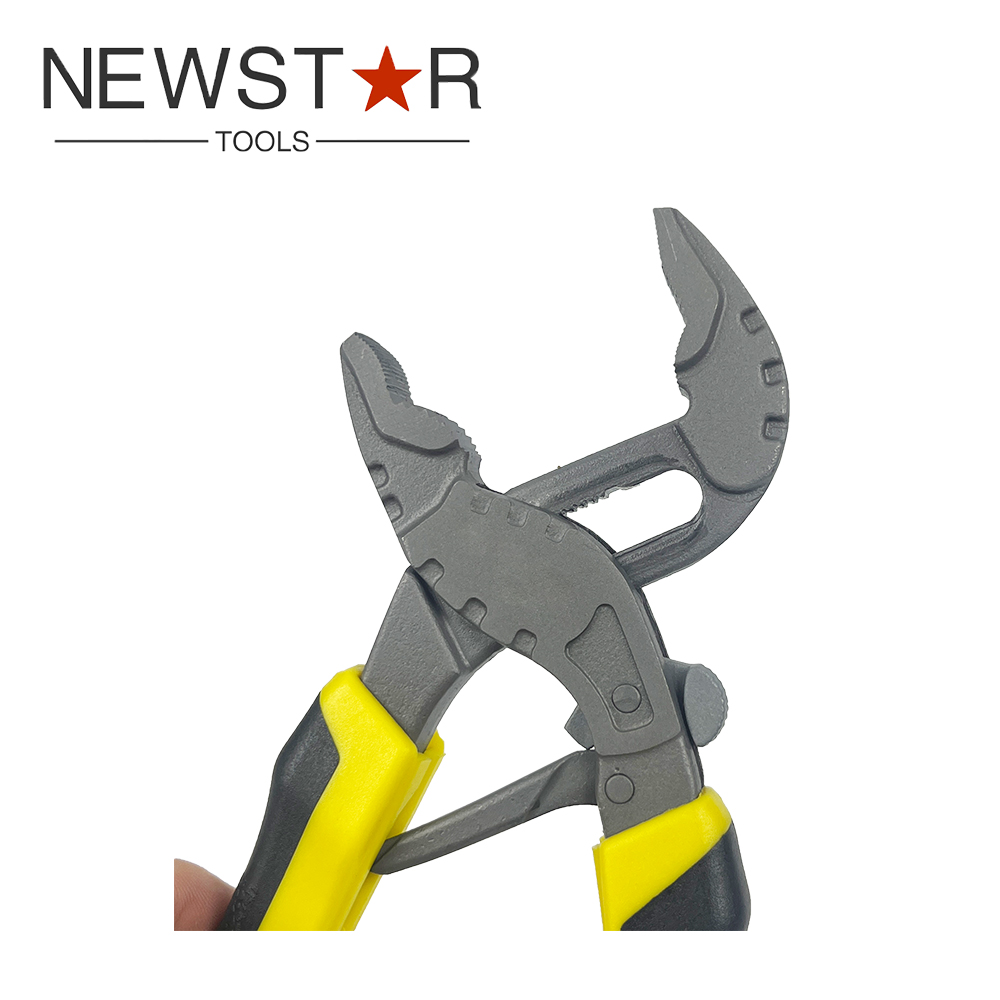
A fine-ratcheting gear mechanism activated by a spring-loaded button characterizes modern adjustable water pump pliers. This operational advantage allows precise sizing to the workpiece. By pressing the button, the user can slide the lower jaw up or down a finely milled track, locking it securely into one of dozens of positions. This eliminates hinge wear and completely prevents accidental size changes under load. The micro-adjustment capability ensures the jaws remain parallel on hex nuts, preventing the rounding of corners. This mechanism represents a significant upgrade in safety, speed, and efficiency over traditional slip-joint designs.
Box-Joint vs. Lap-Joint Construction
The physical construction of the pivot joint dictates the tool's lateral stability. Lap-joint construction involves two halves laid on top of each other and riveted together. Over time, the rivet stretches, causing the jaws to wobble and misalign. Box-joint construction features one handle physically slotted through the center of the other handle. This design provides superior lateral stability, physically preventing the jaws from twisting, bending, or crossing over each other under extreme torque. This structural integrity is required for maintaining a secure grip on heavy-duty applications where lateral forces are high.
Jaw Design and Teeth Geometry for Plumbing Gripping Pliers
V-Jaw vs. Flat Jaw vs. Curved Jaw vs. Parrot-Beak
The shape of the jaw determines how effectively the tool interacts with different materials. Using the wrong jaw profile guarantees workpiece damage and poor torque transfer.
| Jaw Profile | Primary Application | Contact Points | Best Suited For |
| V-Jaw | Round pipes, hex nuts, square profiles | 3 to 4 points | Copper pipe, galvanized fittings, brass unions |
| Curved Jaw | General cylindrical objects | 2 points (broad) | Stripped bolts, large PVC pipes |
| Flat Jaw | Sheet metal, flat stock | Surface area | Bending brackets, pulling wire |
| Parrot-Beak | Aggressive cylindrical gripping | 3 points (high leverage) | Seized iron pipes, rounded fasteners |
V-Jaws are highly effective for gripping round pipes and square or hex profiles by providing three distinct points of contact, preventing the pipe from being crushed. Curved jaws serve well for general cylindrical pipe repair and turning stripped bolts, though they lack the precision of a V-jaw on hex nuts. Flat jaws have severe limitations in plumbing, primarily used for pulling, bending, and holding flat materials. The Parrot-Beak, or self-clamping profile, features specialized geometry designed for maximum mechanical advantage on cylindrical pipes, offering a highly aggressive self-locking grip that bites harder as more pressure is applied.
Teeth Hardness and Directional Bite
The teeth are the primary point of failure on cheap tools. Induction-hardened teeth are vital for wear resistance, ensuring the tool maintains its grip over years of daily use. The hardening process brings the teeth to approximately 60-61 HRC, allowing them to bite into hard materials like galvanized steel without flattening. Furthermore, professional tools feature asymmetrically machined teeth. This directional bite means the teeth are angled backward against the direction of rotation. This geometry forces the teeth to dig deeper into the material as torque is applied, preventing the tool from slipping off the workpiece and maximizing torque application while minimizing physical effort.
Jaw Protection for Delicate Surfaces
Working on chrome-plated, brass, or polished plumbing fixtures requires extreme care. Standard hardened teeth will instantly destroy the finish on a decorative faucet or shower valve. The integration of plastic or non-marring jaw protector covers prevents scratching and gouging. These covers snap over the steel teeth, providing a soft but firm grip. Alternatively, using smooth-jaw variants (often called pliers wrenches) is essential for finish plumbing tasks where aesthetic damage is unacceptable. These tools use parallel smooth jaws to apply massive clamping force without marring the surface.
Evaluation Dimensions: Features to Outcomes
Material Composition and Heat Treatment
The underlying metallurgy dictates whether a tool will bend, break, or endure. Chrome Vanadium (Cr-V) and High Carbon Steel are the standard materials for professional-grade equipment. Cr-V offers an excellent balance of high tensile strength, reduced brittleness, and manageable weight. The manufacturing process is equally important. Drop forging aligns the grain structure of the steel for maximum strength. Following forging, oil-hardening and tempering processes are critical. These heat treatments prevent catastrophic tool failure, such as snapping under heavy loads. A properly tempered tool will bend slightly if pushed beyond its absolute limit, whereas a brittle, poorly treated tool will shatter, sending dangerous metal shrapnel into the workspace.
Handle Ergonomics and Leverage Multipliers
Handle coatings directly impact comfort, grip, and chemical resistance. Dipped PVC handles are easy to clean, maintain a slim profile for tight spaces, and provide a basic non-slip surface. Multi-component or dual-grip handles offer better vibration dampening and higher comfort for continuous use, reducing hand fatigue during long shifts. Regardless of the type, handle sleeves must resist commercial plumbing chemicals. Exposure to PVC primers, pipe dopes, cutting oils, and thread sealants will cause cheap plastics to degrade, swell, or become dangerously slick. Additionally, the handle length relative to the jaw capacity determines the leverage ratio. A longer handle provides a greater mechanical advantage, allowing the user to apply massive torque with minimal effort.
Capacity and Jaw Clearance
Tool lengths map directly to maximum pipe diameter capacities. Selecting the right size is critical for efficiency and accessibility.
- 5 to 6-Inch Models: Ideal for tight clearances, under-sink water supply lines, and carrying in a pocket for quick adjustments.
- 7 to 8-Inch Models: The standard for residential finish work, handling small fixtures and angle stops.
- 10 to 12-Inch Models: The workhorse size for general plumbing, covering most standard residential pipes up to 2 inches.
- 16-Inch and Larger Models: Reserved for commercial mains, large cast-iron fittings, and situations requiring massive leverage.
Matching the tool size to the specific plumbing sector ensures optimal access and torque application. Using a 16-inch tool under a residential bathroom sink is impossible, while using a 7-inch tool on a 2-inch commercial steam line will result in failure.
Trade-Offs and Overall Value Influencing Factors
Heavy Duty Pliers vs. Compact EDC Models
Carrying a versatile 10-inch all-rounder balances size and capability, making it the most common choice for a primary tool bag. However, keeping a 5-inch or 6-inch micro-plier is invaluable for tight spaces where larger handles simply will not fit. Conversely, a 16-inch model handles high-leverage tasks that would otherwise require a pipe wrench. Selecting the right mix depends on the daily task requirements. Technicians who primarily do residential service calls benefit from smaller, more agile tools, while those working on commercial boilers need the leverage of larger models.
Water Pump Pliers vs. Pipe Wrenches
Adjustable pliers offer lighter weight and speed, outperforming heavy pipe wrenches in tight spaces and rapid adjustments. The push-button mechanism allows a technician to size the tool in seconds. However, when absolute torque is mandatory on large, seized iron pipes, traditional Stillson pipe wrenches remain necessary. Pipe wrenches have a floating upper jaw that creates an aggressive wedging action, providing raw power that pliers cannot match. Pliers provide versatility and speed; wrenches provide brute force. Knowing when to switch between the two prevents tool damage and saves time.
Cost vs. Lifespan
Evaluate the total lifespan value when purchasing hand tools. Frequent replacement costs of budget tools, due to rounded teeth, bent handles, and loose pivot joints, quickly exceed the higher upfront investment of premium European or American-made tools. High-quality plumbing gripping pliers deliver consistent performance and outlast cheaper alternatives by years. A premium tool maintains its bite and structural integrity, ensuring that you are not fighting the tool while trying to complete a repair.
Specialty vs. General Purpose
Invest in smooth-jaw pliers to protect chrome fixtures during finish work. Standard toothed pliers are strictly for rough-in work, bare pipes, and seized fittings where surface marring is not a concern. Using the right tool prevents expensive damage to finished surfaces. Replacing a scratched custom shower valve costs significantly more than purchasing a dedicated smooth-jaw tool. General-purpose tools handle 90% of the work, but specialty tools protect your liability on the remaining 10%.
Implementation Risks: Common Failures and Mitigation
Pinching Hazards
The risk of handles closing completely and crushing fingers is a serious safety concern, especially when a tool slips off a fitting under heavy load. Mitigate this by mandating tools with built-in safety stops or anti-pinch guards. This simple geometric feature prevents the handles from touching, saving technicians from painful blood blisters, crushed fingers, and lost work time.
Rust and Joint Seizing
Moisture exposure is constant in plumbing. Tools left wet in a dark bag will rust rapidly. Mitigate rust and joint seizing through proper maintenance protocols. Regularly oil the pivot joint and wipe down the tool after exposure to acidic flux, hard water, or harsh chemicals. A quick wipe with a rag and a drop of machine oil ensures the push-button mechanism and sliding tracks remain smooth and operational.
Workpiece Damage
Aggressive teeth can cause deep gouges in copper, brass, or thin-walled PVC pipes, creating stress risers that lead to future leaks. Mitigate this risk by selecting the correct jaw shape, utilizing the self-locking feature to avoid slipping, and applying appropriate pressure. For delicate materials, use non-marring jaw covers or switch to a smooth-jaw tool. Never use aggressive teeth on thin brass tailpieces.
Conclusion
The optimal tool for professional pipe repair combines a box-joint construction, push-button adjustment, and induction-hardened V-jaws. For residential and finish plumbing, prioritize 10-inch push-button models and smooth-jaw variants to protect fixtures. For commercial and heavy pipe repair, prioritize 12-inch to 16-inch heavy duty pliers with aggressive directional teeth and robust box-joint designs.
- Audit your current tool bag for worn teeth, loose joints, or degraded handles.
- Measure the standard pipe diameters you service daily to determine the necessary jaw capacities for your primary tools.
- Procure a two-piece set, such as a 7-inch and 10-inch model, to cover the vast majority of field applications efficiently.
- Implement a weekly cleaning and oiling routine to prevent rust and maintain the smooth operation of adjustment mechanisms.
FAQ
Q: What is the difference between water pump pliers and groove joint pliers?
A: Groove joint pliers use interlocking machined channels for adjustment, which offer fewer positions and can slip out of alignment. Water Pump Pliers generally refer to modern push-button models offering finer micro-adjustments and a secure locking mechanism that prevents accidental shifting.
Q: What size water pump pliers are best for standard residential plumbing?
A: A 10-inch model is the most versatile size for residential plumbing. It provides enough leverage to break loose stubborn fittings while remaining compact enough to maneuver under sinks and inside standard wall cavities.
Q: How do you maintain plumbing gripping pliers to prevent rust and joint stiffness?
A: Wipe the tools down with a dry rag immediately after use, especially if exposed to soldering flux, pipe dope, or hard water. Apply a few drops of light machine oil to the pivot joint and push-button mechanism weekly to ensure smooth operation.
Q: Can I use water pump pliers on hex nuts without damaging them?
A: Yes, provided you use a smooth-jaw variant or a V-jaw specifically designed to grip the flats of hex profiles. Using standard curved toothed jaws will quickly round off and destroy the corners of brass or chrome hex nuts.
Q: Why do my adjustable water pump pliers keep slipping off the pipe?
A: Slipping usually occurs due to worn, flattened teeth, an incorrect jaw size setting, or using a cheap tool that lacks a self-locking directional bite mechanism. Upgrading to a tool with induction-hardened, asymmetrical teeth solves this issue.
Q: What does a "self-locking" feature mean on pipe repair hand tools?
A: Self-locking means the jaw geometry is engineered to grip the pipe securely once initial pressure is applied. The design forces the jaws tighter as you push down on the handle, requiring minimal squeezing effort to maintain maximum torque during rotation.