In professional electrical and mechanical work, the distinction between precision and power dictates tool selection, directly impacting workflow efficiency and component integrity. Utilizing the incorrect plier profile for high-torque gripping or confined-space manipulation leads to stripped wires, damaged fasteners, premature tool wear, and potential safety hazards. When faced with dense circuit boards or heavy-gauge conduit installations, relying on a single tool profile often results in compromised work quality. This guide provides a technical breakdown of combination pliers and long nose pliers, evaluating jaw architecture, leverage ratios, and application-specific performance to inform your next tooling investment.
- Structural Focus: Combination pliers are engineered as heavy-duty multipurpose pliers, prioritizing maximum leverage for gripping and cutting thick materials.
- Precision vs. Power: Long nose pliers sacrifice high-torque gripping strength to provide extended reach and precise wire manipulation in confined spaces.
- Cutting Capabilities: While both function as wire cutting pliers, combination models feature a pivot point closer to the cutting edge, delivering superior force for heavy-gauge cables.
- Toolkit Integration: Neither tool fully replaces the other; selection should be driven by the specific spatial constraints and torque requirements of your daily applications.
Understanding the Core Anatomy of Electrical Hand Tools
Success Criteria Framing
Defining the baseline structural differences required to evaluate performance in professional environments is the first step in proper tool selection. The physical geometry of electrical hand tools dictates their mechanical advantage, access capabilities, and failure thresholds. Professionals must evaluate tools based on jaw surface area, pivot placement, and metallurgical hardness to ensure the instrument can withstand daily industrial abuse without deforming. We look at how the tool transfers force from your hand to the workpiece. If the jaws flex under load, you lose torque and risk stripping the material. If the cutting edges dent when snapping a hardened wire, the tool becomes a liability on the job site.
What are Combination Pliers?
Combination Pliers feature a highly engineered dual-zone jaw design. The front section consists of a flat, heavily serrated gripping tip designed for flat stock and wire twisting. Immediately behind this flat section lies a curved, serrated pipe-grip cutout, specifically forged to clamp down on round objects like hex nuts, small pipes, and heavy cables. An integrated side-cutting blade is positioned near the fulcrum to maximize shearing force.
These tools serve as the foundational multipurpose option in industrial and construction toolbelts. They consolidate the functions of gripping, twisting, and cutting into a single robust frame. A technical distinction exists between these and traditional lineman's pliers. Combination models typically possess a slightly thinner head profile and the specialized multi-zone jaws, whereas lineman's pliers feature blockier, flat jaws designed almost exclusively for heavy wire twisting and pulling without the pipe-grip cutout. When you are up on a ladder wiring a junction box, having that pipe-grip section allows you to lock onto a stubborn locknut without needing to climb down for a dedicated wrench.
What are Long Nose Pliers?
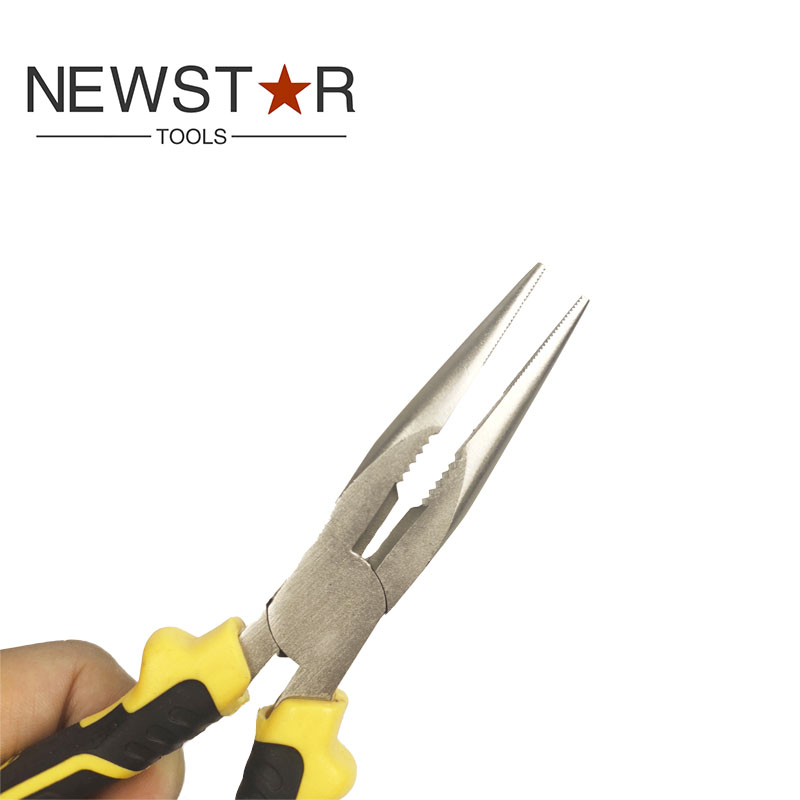
Long nose pliers are defined by their tapered, elongated jaw profile. Often referred to in the field as needle-nose or pinch pliers, this design prioritizes reach and visibility over raw clamping power. The design intent is clear: navigating high-density circuit boards, reaching deep recesses inside engine bays, and executing intricate wire bending where standard plier heads physically cannot fit.
Understanding the nomenclature and design nuances helps prevent tool destruction. Standard long nose pliers maintain a moderate taper that balances reach with some structural rigidity. In contrast, ultra-fine needle nose variations feature extreme taper angles and very thin tips, strictly reserved for micro-electronics. Regardless of the specific variation, all elongated jaw designs face inherent limitations in structural rigidity compared to broader plier heads. Applying high lateral torque to these extended tips will result in jaw misalignment or catastrophic tool failure. You cannot use them to pry staples or twist heavy-gauge solid copper without bending the tips out of alignment.
![Combination Pliers vs Long Nose Pliers]()
Long Nose Pliers vs Combination Pliers: Head-to-Head Technical Evaluation
When analyzing long nose pliers vs combination pliers, professionals must evaluate the physical engineering that dictates tool capabilities. The following dimensions separate heavy-duty performance from precision execution. You need to know exactly how the tool behaves under stress to avoid damaging the workpiece or injuring your hands.
Jaw Profile and Gripping Surface Area
Combination models feature broad, cross-hatched, or heavily serrated jaws designed for maximum friction and surface contact. This aggressive texture bites into materials, making them ideal as primary gripping pliers for seized hex nuts, heavy stock, and thick grounding wires. The wide surface area distributes the clamping force, preventing the tool from slipping under heavy loads. When you grab a piece of unistrut or a thick ground wire, the cross-hatching digs in, locking the material in place.
Conversely, the narrow, finely serrated or smooth jaws of elongated profiles are designed to prevent marring on delicate components. While they provide excellent tactile feedback for holding small resistors or fine copper strands, they are highly prone to slipping under high rotational torque. The reduced surface area cannot generate the necessary friction to hold stubborn fasteners. If you try to loosen a rusted bolt with a long nose profile, the jaws will simply slide off, rounding the bolt head and potentially smashing your knuckles into nearby metal.
Leverage Ratios and Pivot Mechanics
Mechanical advantage is determined by the distance from the pivot joint to the gripping tip relative to the handle length. Combination profiles offer a significantly higher mechanical advantage because they feature a shorter pivot-to-tip distance. This force multiplier allows the user to translate standard hand pressure into massive clamping or shearing force at the jaws. The closer the cutting blade or gripping surface is to the rivet, the less effort you have to exert.
Extended jaw profiles inherently suffer from a poorer leverage ratio. The increased distance from the fulcrum to the tip means that the same amount of hand pressure yields substantially less clamping force at the very end of the tool. This mechanical reality dictates their use for low-torque applications. You are relying on the strength of your grip rather than the mechanical multiplication of the tool's geometry.
Cutting Edge Hardness and Capacity
Both tools frequently function as wire cutting pliers, featuring induction-hardened cutting edges typically rated between 60 and 64 HRC (Rockwell Hardness Scale). However, their capacities differ vastly due to the leverage ratios mentioned above and the sheer mass of steel supporting the blades.
Combination models are capable of shearing ACSR (Aluminum Conductor Steel Reinforced) cable, heavy nails, and thick-gauge solid copper. The blades are thick and supported by the surrounding heavy forging. Elongated models are strictly restricted to snipping light-gauge copper, aluminum, and zip ties. Attempting to cut hardened steel wire with extended jaws risks immediate blade deformation and permanent jaw misalignment. Once you dent the cutting edge on a precision tool, it will never cut fine stranded wire cleanly again.
Overall Dimensions, Weight, and Handle Ergonomics
Heavy-duty models are heavier, featuring robust handles designed to absorb high hand pressure and shock during heavy clamping or cutting. The mass of the tool helps dampen the recoil when snapping through thick wire. Precision models are slimmer, lighter, and often feature shorter handle-to-jaw proportions. This design maximizes tactile feedback, allowing the user to feel the tension on a delicate wire before it snaps.
| Technical Specification | Combination Pliers | Long Nose Pliers |
| Primary Function | High-torque gripping, heavy cutting | Precision manipulation, confined access |
| Leverage Ratio | High (short pivot-to-tip distance) | Low (extended pivot-to-tip distance) |
| Cutting Capacity | Heavy-gauge copper, ACSR, nails | Light-gauge copper, zip ties, soft wire |
| Jaw Rigidity | Excellent under lateral torque | Prone to bending under heavy loads |
| Surface Area | Broad, aggressive cross-hatching | Narrow, fine serrations or smooth |
Matching Plier Types to Professional Applications
High-Torque Gripping and Heavy-Duty Pulling
Mapping tool specifications to real-world operational success requires understanding the physical demands of the task. For high-torque gripping and heavy-duty pulling, the optimal tool is the combination profile. Common use cases include pulling rigid fish tape through long conduit runs, twisting heavy solid-core wires for secure splices, and loosening seized hardware where a wrench cannot fit. The structural integrity of the broad jaws ensures the tool will not deflect under these extreme pulling forces. When you are leaning your entire body weight into pulling a wire through a 90-degree conduit bend, you need a tool that will not slip or snap.
Precision Wire Bending and Confined Space Access
When tasks require precision wire bending and confined space access, the optimal tool shifts to the elongated profile. Use cases involve forming perfect loops for screw terminals, retrieving dropped washers or components deep inside engine bays, and securely holding wires during high-temperature soldering. Utilizing the tapered profile allows professionals to gently guide and bend wire without kinking, nicking, or breaking the internal conductor, which is critical for maintaining electrical continuity. If you nick a solid copper wire while bending it, you create a weak point that will eventually break under vibration or thermal expansion.
Conceptual Trade-offs: Versatility vs. Specialization
Evaluating the efficiency of carrying one heavy-duty tool versus switching between specialized precision tools is a constant field calculation. While multipurpose pliers reduce toolbelt weight and handle a large percentage of general tasks, they fail in specialized scenarios. Attempting to force a bulky head into a recessed electrical box damages surrounding insulation. Conversely, using precision tips to pry a heavy staple will destroy the tool. Professionals must carry both to maintain operational efficiency and protect their equipment.
Evaluation Criteria for Standardizing Your Toolkit
Material Forging and Machining Tolerances
Procuring high-quality equipment requires strict attention to material forging and machining tolerances. The importance of drop-forged Chrome Vanadium (Cr-V) or High-Carbon steel cannot be overstated. Cast metals contain microscopic voids and will shatter under industrial stress. When evaluating a new tool, hold the closed jaws up to a light source. Check for zero daylight between the cutting edges and ensure precise tip alignment. Any gap indicates poor machining and will result in sloppy wire cuts and weak grip. You should also inspect the rivet joint; it should move smoothly without any lateral play. If the joint is loose out of the box, the cutting edges will bypass each other when you try to cut hard wire.
Safety and Compliance Standards
For live electrical environments, safety and compliance standards are non-negotiable. Tools must carry VDE certification and feature 1000V insulated handles tested to withstand massive voltage spikes. Beyond electrical safety, ergonomic handle materials utilizing dual-component grips are necessary to distribute pressure across the palm, significantly reducing the risk of repetitive strain injuries (RSI) during prolonged use. Hard plastic handles will cause blisters and hand fatigue during a long shift of terminating panels. Look for handles that offer a softer rubberized grip zone combined with a hard plastic core for stability.
Implementation Risks and Mitigation
Tool failure often stems from improper application. A primary risk is over-torquing extended profiles, leading to bent or snapped tips. The mitigation strategy is establishing strict usage guidelines—reserving tapered profiles strictly for low-torque, high-precision tasks. Another common risk is dull cutting edges causing wire deformation rather than clean shears, which leads to poor terminal connections. Mitigation involves selecting tools with induction-hardened blades and strictly avoiding cutting materials harder than the tool's specific HRC rating. If you use your good electrical cutters to snip a steel screw, you will ruin the blade instantly.
Conclusion
- Audit your current toolbelt today for worn pivot joints, misaligned jaws, or damaged insulation.
- Discard any tools with dented cutting edges or bent tips, as they compromise work quality and safety.
- Purchase a drop-forged combination plier for heavy manipulation and thick wire cutting.
- Acquire a high-tolerance long nose plier specifically for precision tasks in confined spaces.
- Verify that all new electrical hand tools carry proper VDE 1000V certifications before using them on live circuits.
FAQ
Q: Can combination pliers be used for electrical work?
A: Yes, provided they feature VDE-certified insulated handles rated for the voltage you are working with. Standard dipped handles offer no protection against live electrical currents.
Q: What is the main disadvantage of long nose pliers?
A: Their extended, tapered jaws lack the structural rigidity for high-torque gripping, making them highly susceptible to bending, twisting, or snapping under heavy lateral loads.
Q: Do combination pliers cut wire as well as dedicated diagonal cutters?
A: While highly capable of shearing thick cables, they have a thicker blade profile. Dedicated diagonal cutters offer a flush cut and better access in tight, restrictive spaces.
Q: Why do my long nose pliers have a gap at the base of the jaws?
A: High-quality models are intentionally machined so the very tips touch first. This engineering ensures maximum gripping pressure is applied exactly at the tip before the rest of the jaw closes.
Q: Are combination pliers and lineman's pliers the exact same tool?
A: No. While they share similar functions, combination models feature a slimmer head design and include a curved, serrated pipe grip cutout. Lineman's pliers have flat, blockier jaws optimized strictly for heavy wire twisting.
Q: Is there a difference between long nose pliers and needle nose pliers?
A: In general trade jargon, they are used interchangeably. Technically, needle nose pliers feature much finer, thinner tips meant for micro-electronics, while standard long nose pliers maintain a thicker taper for better grip.