Heating, ventilation, and air conditioning units serve as the lungs of any modern commercial or residential building. When a breakdown inevitably occurs, the line between a quick adjustment and a catastrophic equipment failure often comes down to having the right physical hand tools. Many entry-level technicians and proactive facility managers mistakenly assume climate control repair revolves entirely around digital manifold gauges and multimeters. They forget the foundational mechanics.
Enter the spanner. A premium wrench ensures secure mechanical fittings, prevents toxic refrigerant blowouts, and keeps dynamic blower motors running at peak efficiency. Experienced field engineers know that you do not necessarily need overpriced, niche-branded equipment to achieve a hermetic seal. A rugged automotive toolkit frequently delivers the exact durability and leverage required to service complex climate systems. This guide explores exactly how these indispensable hand tools support field maintenance, the best variations to utilize, and how to select the ideal toolkit for your daily operations.
Key Takeaways
Essential for Operational Safety: Wrenches are critical for tightening high-pressure refrigerant lines and gas valves, preventing toxic leaks that can cause severe system damage or pose immediate fire hazards.
Mechanical Versatility is Key: From securing rattling condenser cages to precisely adjusting heavy compressor mounts, a high-quality wrench handles nearly every physical aspect of heating and cooling repair.
The Tool Crossover Advantage: Heavy-duty toolkits designed for automotive mechanics are highly effective for climate control work due to their comprehensive sizing, high torque capacity, and rugged drop-forged durability.
The Two-Spanner Technique: Using two tools simultaneously to anchor a valve body while turning a nut is a mandatory industry skill. This protects soft copper and brass fittings from twisting and snapping under pressure.
Cost-Effective Investment: Investing in a multi-purpose mechanic set saves significant capital while equipping professionals and proactive homeowners for a wide variety of maintenance tasks.
Navigating Industry Trends: Why Mechanical Precision Matters More Than Ever
Global environmental regulations are rapidly phasing out high global warming potential refrigerants. The industry is aggressively shifting toward high-efficiency heat pumps and mildly flammable refrigerants like R-32. Consequently, the mechanical precision of every single flare nut and service valve is under extreme regulatory scrutiny. A microscopic leak is no longer just a nuisance that degrades cooling capacity; it is a strict environmental compliance failure and a potential safety hazard.
While modern smart diagnostics pinpoint where a fault occurs, technicians still rely entirely on basic mechanical fasteners to physically correct the issue. Without a properly sized wrench to apply exact torque, even the most advanced inverter-driven compressor will eventually fail due to refrigerant starvation. The tools you use to tighten these connections directly impact the lifespan and legality of the installation.
The Critical Role of a Spanner in HVAC Maintenance
Modern air conditioning circuits operate under exceptionally high pressures. Loose brass fittings are empirically proven to be the leading cause of premature system leaks. When a technician fails to properly torque a flare nut on a suction line, pressurized gas slowly escapes into the atmosphere. This loss of charge forces the compressor to overwork, generating excess heat and leading to eventual mechanical burnout. A precision-machined spanner allows you to apply the exact rotational force required to create a leak-proof seal without crushing the soft copper flare.
Furthermore, climate control units are incredibly dynamic machines. Compressors hum aggressively, and condenser fans generate constant high-frequency vibration. Over years of operation, this continuous movement naturally backs out the bolts holding motor isolation pads and outer protective metal casings. Routine preventative maintenance demands systematically retightening these fasteners. Snugging down a rattling cabinet panel reduces noise pollution and mitigates long-term metal fatigue.
Specifically for residential gas furnaces, a heavy-duty wrench acts as a non-negotiable safety device. Connecting rigid black iron gas pipes requires immense mechanical leverage. Using the correct tool ensures pipe threads and union joints are sealed flawlessly, preventing hazardous natural gas leaks that could lead to devastating explosions.
Key HVAC Repairs That Require a Reliable Spanner
The application of this tool extends deeply into the core mechanical repairs required to keep an environment perfectly conditioned. It is not just about taking panels off; it is about securing the heavy moving parts.
Securing Compressor and Motor Mounts
The compressor is typically anchored to the outdoor base pan using heavy-duty bolts and thick rubber isolation dampeners. During a routine changeout, a technician must navigate cramped, sharp metal clearances to break loose rusted mounts. Similarly, indoor blower motors are bolted to heavy galvanized steel brackets. A reliable wrench locks these mounts down, preventing the heavy motor assembly from violently shifting out of alignment during a high-speed cooling cycle.
Adjusting Fan Blades and Pulleys
Picture an outdoor condenser fan spinning at high velocity. The fan blades are secured to the motor shaft using tiny set-screws. If a single blade is even slightly loose, it will wobble. This imbalance throws the entire motor off its axis, destroying the internal bearings within a matter of days. Field engineers rely on precision tools to tighten these set-screws to the manufacturer exact specifications.
Connecting Copper Tubing and Flare Fittings
Perhaps the most delicate physical task in a mini-split installation is joining the line set. Systems frequently use brass flare fittings to connect indoor evaporators to outdoor condensers. Because copper and brass are soft metals, they demand controlled, even force. A high-quality wrench ensures the brass nut is tightened just enough to seat against the copper flare, creating a flawless seal without stripping the delicate threads.
Essential Types of Spanners Every Technician Needs
Not all hand tools belong on a job site. Different tasks dictate specific jaw profiles to prevent equipment damage. Carrying a diverse arsenal allows professionals to address unpredictable field repairs efficiently.
The Adjustable Spanner
This is the versatile workhorse of the service pouch. Technicians frequently encounter decades-old commercial units with mismatched or heavily rusted bolt sizes. An adjustable jaw provides immediate adaptability. It proves particularly useful for holding larger king valve bodies stationary or adjusting the thick leveling feet on a concrete equipment pad. However, seasoned pros avoid using it for high-torque applications on soft brass, as the slight mechanical play can quickly round off the nut.
The Flare Nut Spanner
This specialized tool is absolutely critical for refrigeration work. Unlike a standard open-ended design that grips only two sides of a fastener, a flare nut wrench features a semi-closed ring that wraps around the fitting. Engineered specifically for soft brass flare nuts on copper lines, it evenly distributes torque across multiple contact points. This design effectively prevents the crushing damage that standard tools often inflict on thin-walled piping.
The Combination Spanner
Featuring an open-ended jaw on one side and a closed ring end on the other, this dual-function tool is indispensable. The open end offers rapid turning speed in tight linear spaces. Meanwhile, the closed end delivers slip-free leverage for breaking loose stubborn, heavily oxidized bolts on exterior condenser panels.
Why an Auto Repair Spanner Set is a Secret Weapon for HVAC Pros
A common misconception among apprentices is the supposed necessity of purchasing highly specialized, heavily marked-up tools branded specifically for the cooling industry. The reality of mechanical fastening is universal. Experienced professionals often utilize a premium auto repair spanner set as their primary hand tool arsenal for climate system maintenance.
Automotive tools are rigorously engineered to withstand extreme torque, severe heat-cycling, and heavy rust. These are the exact conditions found inside a decade-old outdoor AC condenser exposed to relentless rain and UV radiation. Drop-forged from high-grade Chrome Vanadium steel and finished with anti-corrosive plating, these tools offer immense structural integrity. They will not flex or snap when you are hanging your entire body weight on a seized compressor bolt.
In addition, comprehensive sizing is a massive operational advantage. The modern equipment landscape is a complex mix of domestic and imported machinery. You might service a commercial rooftop unit requiring standard Imperial sizes in the morning, and a Japanese ductless mini-split requiring Metric sizes in the afternoon. Automotive sets inherently include a continuous range of both, ensuring you are never left scrambling for the exact fit.
What to Look for in a Workshop Combination Wrench Set for HVAC
When upgrading a toolkit for commercial facility maintenance, selecting the right specifications drastically improves efficiency and reduces physical fatigue during grueling summer service calls.
The foundation of a reliable tool lies in its metallurgy. Technicians should strictly seek out sets forged from Chrome Vanadium or Chrome Molybdenum steel. These specific alloys offer a superior strength-to-weight ratio and fiercely resist the galvanic corrosion triggered by damp basements and acidic coil cleaning solvents.
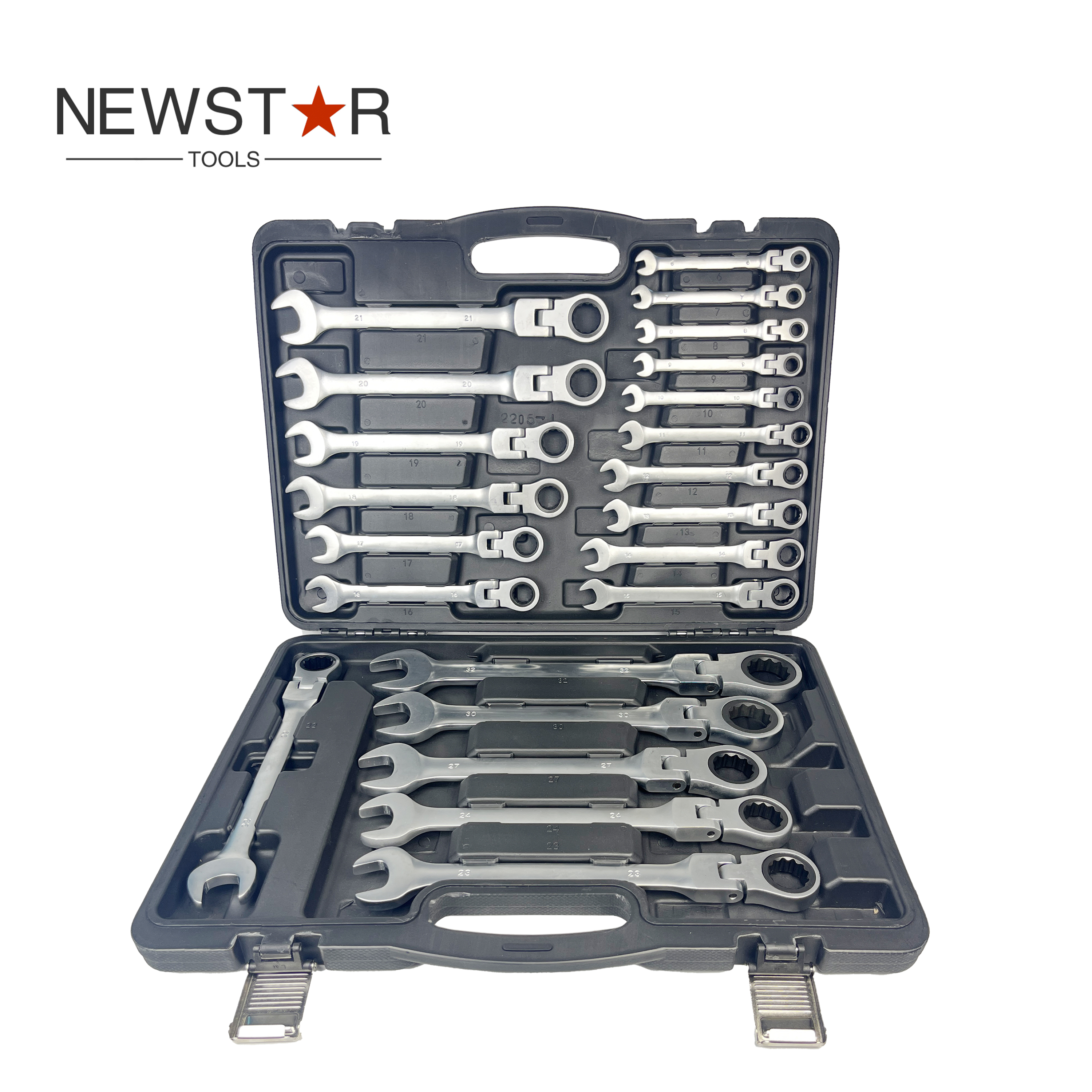
Maintenance frequently requires working in highly confined, frustrating spaces, such as deep inside a cramped furnace cabinet. Opting for a comprehensive workshop combination wrench set that includes ratcheting mechanisms is a massive time-saver. For large-scale commercial sites, a 177-piece set housed in a mobile trolley allows facility engineers to roll their entire inventory directly to the mechanical room. The modular EVA foam trays prevent individual pieces from vanishing into the ductwork insulation, allowing for rapid inventory checks before leaving a job site.
Can You Use a Car Repair Wrench Set for Home HVAC DIY?
For the proactive homeowner, maintaining household equipment is a top priority to avoid exorbitant emergency service fees. If you already own a reliable car repair wrench set packed in a portable blow-molded case, it can absolutely be utilized for basic, safe preventative maintenance.
There are several routine tasks where a homeowner can safely deploy their automotive tools. For instance, using a wrench to carefully unbolt and remove the outer metal louvered cage of the outdoor AC unit allows you to safely vacuum out trapped cottonwood and debris from the delicate condenser fins. This simple act drastically improves airflow and system efficiency. Homeowners can also safely inspect the exterior of their units and tighten any visible, rattling cabinet bolts.
Over time, the dirt pad beneath an outdoor unit naturally settles. You can easily use your tools to adjust the threaded leveling feet on the base pan, ensuring the heavy compressor sits perfectly flat. This geometric alignment is an absolute necessity for proper internal oil lubrication.
In contrast, chemical and thermodynamic repairs are strictly off-limits. Homeowners must never use a wrench to open, loosen, or tamper with sealed copper refrigerant lines, high-pressure service valves, or gas pipe unions. Releasing refrigerants into the atmosphere violates strict environmental regulations, and tampering with gas lines poses a severe explosion risk. Leave the sealed system to certified professionals equipped with recovery machines.
Pro Tips: How to Use Your Spanner Safely on HVAC Equipment
Possessing top-tier tools is merely half the equation. Executing proper mechanical techniques is what separates a flawless professional repair from a disastrous, expensive mistake. Climate control equipment contains fragile components that demand disciplined handling.
In the trade, the absolute golden rule of tightening fittings is the backing up technique. When working with service valves or flare nuts attached to copper tubing, you must use two tools simultaneously. One wrench is anchored on the stationary valve body to hold it completely still, while the second is used to turn the nut. If you attempt to turn the nut with only one tool, the rotational torque transfers directly into the soft copper pipe. The line will instantly kink or snap, triggering a massive, blinding high-pressure refrigerant blowout.
Furthermore, applying more force does not equal a better seal. Soft brass fittings and copper flares are highly susceptible to deformation. Industry standards dictate a snug plus a quarter-turn approach for flare nuts. Over-tightening crushes the copper flare, creating invisible micro-fractures that will inevitably leak under high operational pressure.
Finally, strict tool maintenance prevents workplace injuries. HVAC environments are frequently coated in slick compressor oil, condensation, and grime. Before applying heavy torque, ensure both the tool jaws and the bolt head are wiped completely dry. A slipping wrench under a heavy load is the primary cause of busted knuckles and crushed aluminum coil fins.
Conclusion
While modern climate control technology continues to advance with smart sensors and digital interfaces, the physical integrity of the entire system still relies heavily on properly tightened bolts, nuts, and fittings. A reliable, well-machined spanner remains a non-negotiable asset for daily maintenance and emergency repairs alike.
High-quality toolsets empower both seasoned professionals and proactive homeowners to tackle mechanical wear head-on. Because these versatile hand tools seamlessly handle both automotive repairs and HVAC maintenance, they represent an incredibly smart, cross-functional investment. Take the time to audit your current equipment and retire your worn-out tools. For premium durability, comprehensive sizing, and professional-grade steel, explore the toolkits available at Newstar Hardware to ensure your building systems run safely and efficiently year-round.
FAQ
What size spanner is most commonly used in HVAC?
There is no single universal size, as these complex systems integrate a vast array of components. However, 1/4-inch, 5/16-inch, 1/2-inch, and 9/16-inch are incredibly common for exterior casing panels, motor mounts, and blower assemblies. Because systems often mix Standard and Metric fasteners, owning a complete combination set is far more practical and efficient than attempting to purchase individual standalone tools.
Can I use pliers instead of a spanner for HVAC repairs?
No, using pliers is highly discouraged by field engineers. Pliers utilize serrated teeth that apply uneven, crushing pressure. When used on the soft brass fittings and flare nuts standard in heating and cooling systems, pliers will quickly strip, gouge, and round off the edges of the nut. Once a fitting is rounded, it becomes nearly impossible to tighten or remove properly. Always use a properly sized wrench that applies even pressure to the flat sides of the fastener.
Is there a difference between a mechanic spanner and an HVAC spanner?
Functionally, there is very little difference regarding standard structural bolts and nuts. A high-quality automotive set works perfectly for the vast majority of climate control applications due to its high torque capacity and drop-forged durability. The only highly specialized tool unique to plumbing and refrigeration is the flare nut wrench, which features a partially closed head designed specifically to grip multiple sides of soft tubing nuts without crushing the internal pipe.
Why do HVAC technicians use two spanners at once?
This technique is professionally known as backing up. One tool is used to hold the base of the valve or fitting completely stationary, while the second is used to apply turning force to the nut. If a technician only uses one tool, the twisting motion will transfer directly into the delicate copper pipe attached to the fitting, causing the pipe to kink, collapse, or snap off entirely.
Can a loose fitting cause my AC to freeze up?
Absolutely. If a flare nut is not properly tightened with a wrench, pressurized refrigerant will slowly leak out. As the system loses its refrigerant charge, the internal pressure drops, causing the evaporator coil temperature to plummet below freezing. Condensation in the air then freezes onto the coil, creating a solid block of ice that completely blocks airflow and stops the cooling process.
What is the best material for HVAC hand tools?
Professional technicians should look for tools forged from Chrome Vanadium or Chrome Molybdenum steel. These alloys are heat-treated to withstand immense torque without bending. Additionally, because HVAC tools are constantly exposed to moisture, acidic coil cleaners, and outdoor weather, a high-quality chrome or black oxide finish is essential to prevent severe rust and galvanic corrosion.