Facility management is a relentless battle against wear and tear. You never know if your morning will start with a blown breaker in a commercial lobby or a massive plumbing leak in a residential unit. The scope of work is vast, and the environment is unforgiving. The efficiency of your maintenance crew relies heavily on the quality, durability, and accessibility of their equipment. When technicians carry the right gear, work orders are closed faster. Operational costs decrease.
Piecing together mismatched equipment often leads to a chaotic workflow. It causes lost items, wasted time walking back to the maintenance shed, and inefficient repairs that ultimately frustrate tenants. Imagine a technician arriving at a job site to fix a plumbing leak, only to realize they are missing a crucial basin wrench. Time is money. The resulting delay negatively impacts the property's overall service metrics and damages resident trust.
Investing in comprehensive, purpose-built gear is a highly cost-effective way to empower your facility staff. Standardized kits eliminate the guesswork from daily operations, providing workers with exactly what they need to succeed on the first try. In this guide, we will explore the critical factors involved in selecting the best equipment for your team. Specifically, we will examine the operational benefits of structured storage, identify the exact scenarios where a lightweight kit is most appropriate, and discuss why heavy-duty rolling carts are the ultimate upgrade for large-scale facility management.
Key Takeaways
Equipping your maintenance crew with dedicated gear improves repair speed, enhances first-time fix rates, and boosts overall tenant satisfaction.
A basic tool collection is highly effective for quick everyday unit turnovers and light cosmetic repairs.
Investing in kits with molded hard cases drastically reduces the financial burden of lost or misplaced equipment through visual inventory control.
For large-scale properties and comprehensive system repairs, rolling workstations provide unmatched efficiency and versatility.
Standardizing your crew's gear makes inventory tracking, maintenance audits, and budget forecasting much easier for property managers.
Current Industry Trends in Facility Equipment Management
The property management sector is experiencing a massive shift toward modularity and visual control. Recent industry analyses highlight a growing shortage of skilled tradespeople across the maintenance sector. Because hiring experienced technicians is harder than ever, property managers are forced to maximize the output of their existing staff. This dynamic has sparked a major trend away from chaotic bulk tool bags toward strict visual inventory systems and mobile workstations.
Standardizing equipment across a portfolio is no longer just a luxury. It is a critical strategy to combat labor shortages and reduce wasted transit time across sprawling campuses. Furthermore, as buildings incorporate more complex smart-home technologies and advanced HVAC systems, the demand for specialized, professional-grade diagnostic and repair gear has skyrocketed. Crews simply cannot rely on consumer-grade hardware to maintain modern commercial infrastructure.
Why Standardized Hand Tool Sets Matter for Maintenance Crews
Transitioning a maintenance team from a fragmented collection of individual items to standardized kits offers a measurable return on investment. Property managers often make the mistake of purchasing cheap replacements on an as-needed basis. Over time, this results in a disorganized collection of mismatched equipment. The benefits of standardization extend far beyond mere convenience, directly impacting labor costs and tenant retention.
Boosting Crew Efficiency and First-Time Fix Rates
The First-Time Fix Rate, or FTFR, is a critical performance metric in property management. It measures the percentage of maintenance requests resolved during the technician's initial visit. When a worker arrives at a unit with a comprehensive kit, they are prepared for multiple scenarios. Having the right wrench, screwdriver, or plier immediately on hand prevents the need for call-backs or driving to a local hardware store. Reducing this transit time—often referred to in the industry as windshield time—directly increases the number of work orders a technician can complete in a single shift.
Reducing Tool Loss and Replacement Costs
Tool attrition is a significant hidden cost in facility management. When tools are tossed loosely into a canvas bag or a plastic bucket, it is nearly impossible to track inventory. Consequently, items are frequently left behind in tenant units or dropped in dark mechanical rooms. Standardizing the kits across your entire team creates a strict system of accountability. If every technician is issued the exact same setup, managers can easily verify inventory during routine checks. Technicians are much more likely to take ownership and care of a professional set assigned specifically to them.
Professional Appearance to Tenants
Tenant retention is closely tied to the perceived quality of maintenance services. The physical appearance of your crew influences how residents view the management company. A technician who arrives carrying a disorganized, rusty bucket of parts may inspire doubt regarding their competence. By contrast, a worker who shows up with a clean, well-organized hard case projects professionalism and respect for the tenant's living space. This subtle psychological factor helps build trust and reassures residents that their home is in capable hands.
Core Components Every Property Maintenance Tool Kit Needs
Not all kits are created equal. While consumer-grade options might suffice for occasional weekend projects, property maintenance requires a baseline of professional-grade tools designed to handle daily wear and tear. A high-quality setup must cover the three primary domains of property repair: plumbing, electrical, and general carpentry.
Plumbing Essentials
Water-related issues represent a massive portion of emergency work orders. Dripping faucets, running toilets, and clogged P-traps require immediate attention. To address these efficiently, a kit must include adjustable wrenches for loosening supply lines and heavy-duty pipe wrenches for larger fixtures. Slip-joint pliers and groove-joint pliers are necessary for gripping pipes of various diameters. Consumable items like Teflon tape should always be stocked within the case to ensure watertight seals on threaded connections.
Electrical and Lighting Basics
Electrical repairs demand precision and uncompromising safety. Basic tasks during unit turnovers include replacing light fixtures, swapping out faulty outlets, and resetting breakers. The set must feature wire strippers capable of handling standard gauge wiring. Insulated screwdrivers are a mandatory safety requirement to protect workers from accidental shocks. A reliable non-contact voltage tester is essential so technicians can verify that power is fully disconnected before beginning any work. Needle-nose pliers are also required for bending wires to fit securely around terminal screws.
General Carpentry and Hardware Repair
Beyond pipes and wires, crews constantly deal with drywall damage, loose cabinet hinges, and sticking doors. A standard claw hammer and a durable 25-foot tape measure are non-negotiable components. A retractable utility knife is required for cutting drywall, opening packages, or scoring materials. Hex keys, commonly known as Allen wrenches, are frequently needed for repairing modern furniture, commercial door handles, and garbage disposals. Finally, a ratcheting multi-bit screwdriver saves valuable space while providing the versatility to tackle Phillips, slotted, Torx, and square-drive screws.
The Role of a Household Hand Tool Set in Property Management
While heavy-duty repairs require specialized equipment, a significant percentage of property maintenance involves minor, surface-level adjustments. Understanding the distinction between heavy industrial gear and light-duty kits can help property managers allocate their resources more effectively.
Perfect for Light Unit Turnovers
When a tenant moves out, the apartment must be quickly prepared for the next resident. This process often involves simple cosmetic tasks like tightening loose cabinet pulls, installing new window blinds, or hanging smoke detectors. Lugging around a 50-pound industrial toolbag for these specific tasks is highly inefficient and physically draining. A compact, lightweight household hand tool set provides exactly what is needed. These sets typically feature essential carbon steel pliers, standard precision screwdrivers, and basic measuring tools, allowing turnover specialists to move swiftly from unit to unit without unnecessary fatigue.
Equipping Leasing Agents and Office Staff
Maintenance technicians are not the only staff members who encounter repair needs. Property managers and leasing agents frequently conduct unit walkthroughs with prospective tenants. If a client points out a loose screw on a closet door, dispatching a senior technician to fix it is a poor use of skilled labor hours. By keeping a basic kit in the leasing office, administrative staff can immediately resolve minor, non-hazardous issues on the spot. This proactive approach delights tenants, closes leasing deals faster, and keeps the main maintenance queue clear for high-priority work orders.
Maximizing Accountability with an Organized Hand Tool Set
Protecting your capital investment in equipment requires a structural approach to storage. Property managers are increasingly moving away from bulk tool bags to prevent the black hole effect where expensive gear disappears into the bottom of a canvas sack.
The Benefit of Molded Hard Cases
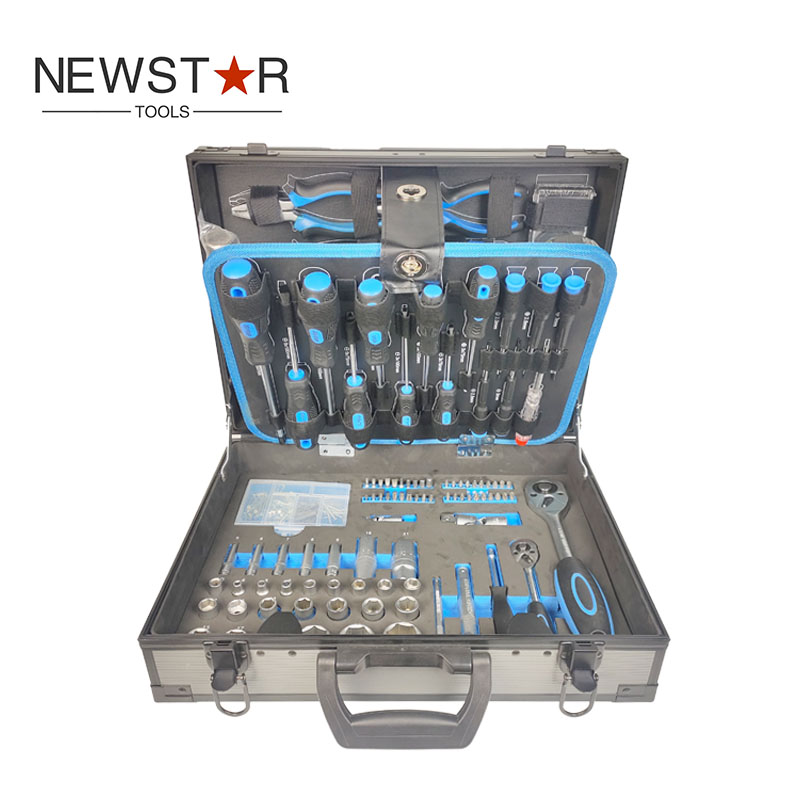
The primary advantage of a structured toolkit is visual inventory management. Cases featuring blow-molded slots utilize strict organizational methodologies. Every single wrench, socket, and plier has a designated, custom-shaped slot. At the end of a long shift, a technician can look at their organized hand tool set and instantly notice if an empty slot remains. This simple visual cue prompts them to retrieve the missing item from under a sink or behind a boiler before leaving the job site, drastically reducing the annual budget spent on replacing lost gear.
Durability for the Daily Grind
Property maintenance is a physically demanding environment. Tools are frequently dropped on concrete floors, exposed to moisture, and subjected to high torque. Therefore, the materials matter immensely. Professional sets should be manufactured from Chrome Vanadium, or Cr-V, steel. This specific alloy offers a superior balance of hardness and toughness, preventing the metal from snapping or stripping under pressure. The outer hard case must feature reinforced hinges and heavy-duty latches to survive being tossed into the back of a maintenance golf cart day after day.
Scaling Up: When to Invest in a Mobile Workshop Tool Set
As multi-family residential complexes and mixed-use commercial spaces grow larger, the logistics of maintenance change completely. This scale drives the adoption of mobile workstations, designed specifically to minimize dead time spent walking across sprawling campuses.
Bringing the Maintenance Shop to the Repair Site
In massive buildings, the central maintenance shop might be located in a basement far from the actual repair site. If a technician is performing a major HVAC blower motor replacement or overhauling an entire boiler system, a standard portable kit simply will not hold the necessary specialized equipment. A mobile workshop tool set acts as a portable base of operations. Equipped with industrial casters, these multi-drawer carts allow lead technicians to transport hundreds of pounds of equipment directly into a mechanical room, eliminating the need for multiple exhausting trips.
Ultimate Tool Variety and Storage
Complex repairs require a vast array of socket sizes, specialized wrenches, and diagnostic equipment. Professional rolling workshops often feature up to 177 pieces, encompassing deep sockets, torx bit sockets, breaker bars, and specialized automotive-style tools that are highly applicable to commercial property maintenance. The multi-drawer design keeps these extensive inventories perfectly categorized. For a lead maintenance supervisor, this level of variety is not a luxury. It is a strict operational requirement to ensure minimal downtime for critical building systems.
Selecting the appropriate equipment requires a strategic assessment of your property's specific needs. Over-equipping your team wastes capital, while under-equipping them wastes precious labor hours. Use the following core comparison to match the gear to your operational demands.
Equipment Tier
Best Suited For
Key Features & Materials
Primary Operational Advantage
Lightweight Household Kit
Unit turnovers, administrative staff, light cosmetic repairs
Carbon steel components, basic pliers, screwdrivers, compact soft or hard case
High portability, low cost, prevents fatigue during rapid unit inspections
Cr-V steel, blow-molded slots, comprehensive socket and wrench sets
Visual inventory control, extreme durability, reduces lost tool expenses
Mobile Workshop Trolley
Lead engineers, large commercial facilities, boiler rooms
170+ pieces, multi-drawer rolling cart, industrial casters, breaker bars
Brings the entire maintenance shop to the repair site, eliminates transit time
Best Practices for Maintaining Your Crew's Gear
Purchasing high-quality equipment is only the first step. To ensure these assets last their expected lifespan, property managers must implement strict maintenance protocols. Proper care prevents rust, maintains functionality, and enforces crew accountability.
Routine Tool Audits
To maximize the value of your gear, management should conduct routine audits. Once a month, maintenance supervisors should inspect each technician's kit. Because structured cases feature molded slots, this audit takes less than two minutes per worker. If an item is missing, it must be reported and replaced immediately. This practice ensures the technician is always prepared for the next job and reinforces a culture of asset protection.
Cleaning and Rust Prevention
Property maintenance frequently exposes equipment to water and harsh drain chemicals, especially during plumbing repairs under sinks. If wet tools are placed back into a closed case, trapped moisture will rapidly cause oxidation, deteriorating the metal. Technicians must be trained to wipe down all metal surfaces with a clean rag after exposure to moisture. Applying a light coat of water-displacing lubricant to the moving parts of adjustable wrenches and ratchets will prevent seizing and significantly extend the life of the equipment.
Conclusion
A maintenance crew is only as effective as the tools they carry. The right equipment fixes problems efficiently, reduces operational bottlenecks, and keeps tenants happy. Whether you are providing a simple kit for fast cosmetic repairs or outfitting a lead technician with a comprehensive rolling cart for major mechanical overhauls, matching the gear to the job is paramount.
By investing in structured, high-quality kits, property managers can cut down on wasted transit time, eliminate the hidden costs of lost equipment, and ensure residents receive fast, professional service. Upgrade your crew's gear today to streamline your daily operations and protect your property's bottom line. Evaluate your team's specific needs and explore the professional-grade solutions available at Newstar Hardware to find the perfect configuration for your facility.
Frequently Asked Questions
What is the difference between a standard toolkit and an organized hand tool set?
An organized set comes with a custom-molded hard case or EVA foam inserts where every specific tool has a designated slot. This prevents tools from rattling around, protects them from damage, and allows maintenance workers to instantly notice if a tool is missing before leaving a job site. A standard toolkit often involves loose tools thrown haphazardly into a soft bag.
Should every member of my maintenance crew have their own gear?
Yes, it is highly recommended. Providing each technician with their own equipment creates personal accountability, prevents arguments over shared tools, and ensures multiple workers can tackle different work orders simultaneously in different areas of the property without waiting on each other.
Is a basic household kit durable enough for professional property maintenance?
While these lightweight kits are incredibly useful for light duties—such as adjusting cabinet doors, hanging fixtures, or minor drywall patching—heavy-duty tasks like commercial plumbing overhauls or HVAC repairs will require a professional-grade kit made of stronger steel alloys that can withstand high torque.
What are the most essential tools for a new maintenance technician?
A new technician should start with a core selection of professional-grade basics. This includes a high-quality multi-bit screwdriver, adjustable wrenches, slip-joint pliers, a non-contact voltage tester, wire strippers, a utility knife, and a durable tape measure. These cover about eighty percent of standard daily work orders.
How do rolling tool carts improve maintenance efficiency in large buildings?
Rolling carts drastically reduce windshield time. Instead of a technician making three separate trips to the basement maintenance shop to grab different socket sizes or breaker bars for a boiler repair, they can roll a comprehensive 170-piece workshop directly to the mechanical room, keeping them actively working on the repair.
What is a mobile workshop tool set, and who needs one?
This is typically a multi-drawer tool trolley or rolling cart loaded with hundreds of professional-grade tools. It is ideal for head maintenance supervisors, large commercial facilities, or sprawling properties where technicians need a wide variety of specialized tools transported directly to a specific unit or boiler room without making multiple trips.
How often should I replace my property maintenance gear?
If you invest in high-quality sets made from Chrome Vanadium steel and enforce proper tool maintenance, a good set can last several years. You should only need to replace individual pieces if they are lost or if tools with internal moving parts, like ratchets, eventually wear out from heavy daily use.