Did you know a single loose screw can completely compromise the structural integrity of a newly manufactured piece of furniture? On a fast-paced factory floor, cycle times dictate profitability. Rushing the assembly line often leads to weak joints and improperly driven fasteners. These defects inevitably result in severe safety hazards. More importantly, they cause costly product returns and irreversible damage to your brand reputation.
To combat these challenges, manufacturers must implement highly reliable fastening solutions. Whether a facility is churning out premium solid oak dining tables or mass-producing flat-pack particleboard wardrobes, the exact tools utilized on the floor dictate ultimate quality. In this comprehensive guide, we explore the intricate workings of modern assembly lines. We will examine the delicate balance between automation and human craftsmanship, breaking down the essential equipment needed to maintain structural perfection.
Key Takeaways
Fastening tools are critical for ensuring the load-bearing capacity and longevity of commercial furniture.
A well-equipped assembly line requires a strategic mixture of high-speed automated pneumatic systems and precision manual instruments.
Prioritizing ergonomic design and precise torque control drastically reduces worker fatigue while preventing irreversible damage to engineered wood composites.
Investing in high-quality, comprehensive kits streamlines daily production, enforces inventory organization, and significantly minimizes line downtime.
Despite the rapid industry shift toward robotics, highly reliable manual tools remain indispensable for quality assurance and executing custom finishes.
The Role of Fasteners and Tools in Furniture Structural Integrity
On a bustling factory floor, the fastening phase dictates the entire production cycle. The structural integrity of any given piece of furniture depends entirely on the physics of its connection points. Furniture is continuously subjected to dynamic and static loads. A lounge chair must effortlessly withstand the shifting weight of human occupants. A towering bookshelf must resist the continuous downward shear force exerted by heavy volumes.
Connection points like corner brackets, hidden hinges, and dowel joints are the most vulnerable zones. Even if a factory sources premium-grade timber and highly engineered fasteners, the final product will inevitably fail if these components are not properly secured. The application of the fastener is just as vital as the hardware itself. Driving a structural screw at an incorrect angle instantly compromises the shear strength of the joint. Similarly, leaving a bolt fractionally loose allows micro-movements over time. These movements widen pre-drilled holes, leading to a complete structural collapse. Precise application of force is the foundational element that mitigates safety hazards and protects a manufacturer's bottom line.
Core Types of Fastening Tools Used on the Assembly Line
A commercial furniture factory operates under strict cycle times and rigorous quality standards. To meet these relentless demands, assembly lines are equipped with specific categories of tools meticulously assigned to distinct phases of the workflow.
Pneumatic and Electric Power Tools
For high-speed, repetitive tasks, pneumatic air-powered tools and electric power tools are the undisputed standard. Pneumatic nail guns and heavy-duty staple guns are heavily utilized in upholstery framing. Here, hundreds of staples must be driven into softwood frames in a matter of minutes. Furthermore, electric impact drivers and specialized clutch-driven screwdrivers are deployed for attaching large back panels or driving long structural lag screws. These instruments are selected for their rapid operational capacity, allowing workers to maintain high output rates without succumbing to physical strain.
Precision Fastening Hand Tools
Despite the overwhelming prevalence of power tools, manual fastening hand tools remain an absolute necessity on modern assembly lines. Power tools often lack the nuanced tactile feedback required for delicate operations. Softwoods like pine and engineered composites like particleboard are highly susceptible to thread stripping if a screw is over-driven by even a fraction of a millimeter. Manual instruments allow line workers to physically feel the subtle resistance of the material. This sensory feedback makes them essential for delicate hardware installation, adjusting intricate soft-close hinge mechanisms, and performing final manual tightening.
The Importance of a Screwdriver and Wrench Set
Modern furniture design incorporates a dizzying array of proprietary and standardized fasteners. A single modular workstation might require Phillips screws for cabinet hinges, Hex bolts for the primary structural framing, and Torx screws for attaching decorative exterior elements. Having immediate access to various drive types ensures that workers do not waste precious cycle time searching for adapters or swapping out individual tools.
Socket and Wrench Tools for Heavy-Duty Assembly
Standard screwdrivers handle wood and composite materials perfectly. In contrast, heavy-duty assembly requires a vastly different mechanical approach. Industrial-style dining tables, height-adjustable office workstations, and commercial metal bed frames rely on thick steel bolts and heavy nuts to achieve absolute stability. In these high-stress scenarios, ratcheting socket wrenches allow for rapid tightening in confined spaces. The superior mechanical advantage provided by these tools ensures that heavy metal-to-metal connections remain entirely rigid under commercial use.
Step-by-Step: How Fastening Tools Operate in the Assembly Process
To understand the true impact of these instruments, it is helpful to observe how a product physically moves through a standard manufacturing facility. The assembly line is divided into highly specialized stations optimized for specific fastening operations.
Station 1: Frame and Base Construction
The manufacturing process begins with the skeleton of the furniture. At this initial station, workers handle the thickest, most unforgiving materials like solid wood posts or extruded steel tubing. Heavy-duty tools, including pneumatic impact wrenches and large-drive socket sets, are deployed here. The primary objective is to establish a perfectly rigid base. High torque is applied to heavy machine screws to ensure the foundational frame will not warp as subsequent lighter components are added.
Station 2: Panel Attachment and Joining
Once the primary frame is secure, the product advances to panel attachment. This station frequently handles engineered wood-based boards, which require a delicate touch. Workers use specialized custom jigs that hold panels at perfect 90-degree angles. Fastening tools utilized here are typically clutch-controlled electric screwdrivers. These devices are precisely calibrated to drive screws exactly flush with the surface, ensuring delicate veneer finishes are not split during insertion.
Station 3: Hardware, Hinges, and Upholstery
The final assembly stages demand the highest level of finesse. Installing smooth drawer slides, soft-close hinges, and decorative brass handles cannot be rushed. Workers at this station rely heavily on low-torque electric screwdrivers and ergonomic manual hand tools. A single stripped screw in a drawer slide will result in a misaligned track, leading to immediate quality assurance rejection. Upholstery elements are also attached at this stage, seamlessly blending pneumatic staplers for fabric retention with manual wrenches to secure padded seating.
Assembly Line Ergonomics: Boosting Productivity and Safety
Beyond the mechanical aspects, the human element of the assembly line is a primary driver of factory efficiency. Repetitive Strain Injuries, such as carpal tunnel syndrome and chronic tendonitis, are significant occupational hazards in furniture manufacturing. When operators are required to drive hundreds of screws per shift, the physical toll directly impacts workplace safety and daily output.
To actively combat this fatigue, modern factories heavily prioritize tool ergonomics. Production lines now frequently utilize tool balancers. These spring-loaded cables suspended from overhead rails hold the dead weight of heavy pneumatic and electric tools. This ingenious system allows the worker to guide the tool freely without bearing its physical mass. Furthermore, the geometric design of manual tools plays a crucial role. Hand tools featuring rubberized, contoured dual-material grips distribute pressure evenly across the palm. When workers experience less fatigue, their operational precision naturally increases. They are far less likely to accidentally drive a fastener at a crooked angle.
Torque Control and Quality Assurance in Manufacturing
In commercial furniture assembly, fastening is an exact science. A prevalent misconception among novices is that screws and bolts should simply be driven as tightly as humanly possible. In reality, improper tensioning is a leading cause of catastrophic product failure. Different manufacturing materials possess vastly different torque tolerances. Solid maple can withstand significantly higher torque than Medium Density Fiberboard. Over-tightening a screw in engineered wood will instantly pulverize the internal fibers, stripping the hole and rendering the joint entirely useless. Under-tightening leaves a microscopic gap between materials, resulting in wobbly furniture.
Tool Category
Primary Application
Torque Control Level
Best Suited Materials
Pneumatic Power Tools
High-speed framing, upholstery
Low to Medium
Softwoods, Hardwoods
Clutch-Driven Screwdrivers
Panel joining, hinge installation
High
Medium Density Fiberboard, Particleboard
Manual Hand Tools
Delicate hardware, QA finishing
Absolute Precision
Veneers, Fragile Composites
Heavy-Duty Sockets
Base construction, metal frames
Maximum Yield
Steel Tubing, Thick Bolts
To maintain uncompromising quality assurance, factories implement meticulously calibrated torque tools. Pneumatic drivers are fitted with mechanical clutches that automatically disengage the moment a specific torque metric is reached. For critical structural joints, quality control inspectors frequently utilize a standardized screwdriver and wrench set equipped with manual torque indicators to test random samples pulled directly off the line. This empirical, data-driven approach ensures every single piece of furniture possesses the exact same structural integrity before it reaches the consumer.
Industry Trend: Smart Manufacturing vs. Human Craftsmanship
The modern manufacturing landscape is currently undergoing a rapid technological transformation. Recent industry analyses indicate a profound shift towards smart manufacturing. Internet of Things enabled torque drivers and collaborative robots are increasingly integrated into traditional assembly lines. Market reports suggest that automated fastening fixtures can boost panel-joining throughput by up to thirty percent. Yet, the demand for hybrid assembly models is actually surging.
Automation excels at highly repetitive, linear tasks. However, robots inherently struggle with complex, multi-angle geometries. They lack the tactile sensory feedback required to navigate natural material anomalies, such as avoiding a hidden knot in solid timber. High-end, bespoke, or intricate furniture still relies heavily on the spatial awareness of skilled human operators. During custom finishing or complex hardware installation, workers rely on professional socket and wrench tools to navigate intricate angles. They apply substantial manual torque that automated arms cannot safely replicate without the risk of cross-threading. In this hybrid model, human craftsmen act as the final line of defense, ensuring that rapid automation never comes at the cost of enduring quality.
Choosing the Right Fastening Tool Kits for Your Production Line
For procurement managers and factory owners, selecting the appropriate tooling is a critical capital decision that directly impacts the bottom line. Purchasing cheap, unverified equipment inevitably leads to stripped fasteners, shattered bits, and exceedingly expensive line downtime. When outfitting an assembly line, several objective criteria must be rigorously evaluated.
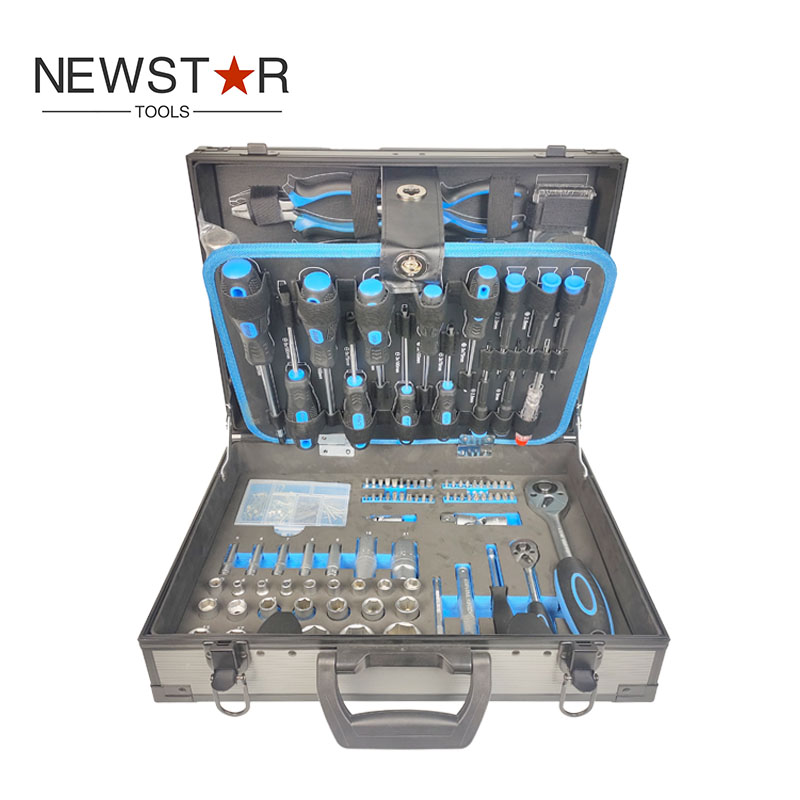
First and foremost, evaluate material durability. Tools subjected to the relentless environment of industrial manufacturing must be forged from high-yield materials. Chrome Vanadium steel is the recognized industry standard for sockets and wrenches. It offers exceptional resistance to torque fatigue and chemical corrosion. Secondly, enforce inventory organization. On a sprawling factory floor, lost tools equate to wasted time and potential shipping hazards. Tool kits must feature organized, precision-molded hard cases. This allows shift managers to perform rapid visual inventory checks at the end of the day, ensuring no stray tools are left inside assembled furniture.
Finally, demand versatility to ensure maximum return on investment. Comprehensive tool sets that include auto-repair grade components are highly recommended. Robust ratchets and deep sockets designed for automotive mechanics double perfectly for heavy-duty furniture assembly. They seamlessly bridge the gap between delicate woodworking and heavy commercial steel racking.
Conclusion
Ultimately, the efficiency and success of a furniture assembly line are directly tied to the quality and appropriate application of its fastening tools. Proper equipment not only ensures the structural integrity of the final product but also significantly extends its functional lifespan. As the industry evolves, factories must continuously balance the sheer speed of automated systems with the nuanced precision of reliable manual instruments. By investing in high-quality, ergonomically designed tool kits, manufacturers can actively prevent costly production errors and protect their workforce from injury.
Upgrading your facility's hardware solutions is a strategic commitment to producing safe, world-class furniture. Ready to eliminate line downtime and enforce strict quality control? Equip your assembly line with professional-grade instruments. Visit Newstar Hardware today to find the perfect fastening solutions and comprehensive tool kits tailored for your manufacturing needs.
FAQ
What are the most common fastening tools used in furniture manufacturing?
The most common fastening tools utilized in commercial furniture manufacturing include pneumatic staple guns, electric impact drivers, and calibrated torque wrenches. These power tools handle the rapid framing and joining of large panels. Additionally, comprehensive manual screwdriver sets are universally employed across assembly lines for installing delicate hardware, such as cam locks and decorative hinges, where precision is far more critical than sheer speed.
Why do assembly lines still use manual fastening hand tools?
Manual tools remain absolutely essential because they offer a level of precision and tactile feedback that automated or power tools simply cannot replicate. When working with delicate hardware or soft composite woods, a human operator using a manual tool can physically feel the resistance of the screw. This tactile response allows the worker to stop applying force at the exact moment the joint is perfectly secure, effectively preventing stripped threads and ensuring meticulous quality control.
How do socket and wrench tools differ from standard screwdrivers in furniture assembly?
These tools serve entirely different mechanical purposes on the factory floor. Standard screwdrivers are designed to drive threaded screws directly into wood or plastic panels, typically requiring lower torque. In contrast, socket and wrench tools are utilized for heavy-duty applications that involve fastening thick nuts and bolts together. This is frequently seen in the assembly of industrial-style furniture, such as attaching heavy steel legs to a solid wood dining table, which requires immense clamping force.
How does tool ergonomics affect furniture production?
Tool ergonomics directly impacts the physical stamina, safety, and focus of the assembly line worker. Ergonomically designed tools reduce harsh vibrations, distribute weight evenly across the hand, and promote neutral wrist postures. By minimizing physical strain, these tools drastically decrease the likelihood of repetitive strain injuries and fatigue-related errors. Consequently, ergonomic interventions speed up the overall production process and ensure that manufacturing quality remains consistent throughout an entire shift.
Can auto repair tool kits be used for furniture assembly?
Yes, auto repair tool kits are highly effective and frequently recommended for furniture assembly, particularly in commercial or heavy-duty manufacturing environments. These robust kits contain professional-grade ratchets, deep sockets, and combination wrenches forged from highly durable steel. They are perfectly suited for assembling large-scale commercial furniture, metal bed frames, or industrial workstations that utilize thick bolts and require torque levels that standard household toolkits simply cannot safely provide.
How do you prevent screws from stripping in engineered wood furniture assembly?
Preventing stripped screws in engineered wood requires strict torque control and proper pilot holes. Assembly line workers must use clutch-driven electric screwdrivers calibrated to disengage before the screw over-rotates. Additionally, finishing the fastening process with a manual hand tool allows the operator to feel the exact moment the screw head sits flush against the material, preventing the destruction of internal wood fibers.
What is the difference between an impact driver and a clutch-controlled screwdriver on the assembly line?
An impact driver uses rotational strikes to deliver massive amounts of uncontrolled torque, making it ideal for driving long lag bolts into solid hardwood frames. Conversely, a clutch-controlled screwdriver delivers smooth, consistent rotational force that automatically stops at a pre-set limit. Clutch-controlled tools are mandatory for delicate panel joining and hinge installation, where excessive force would instantly damage the hardware or the wood composite.