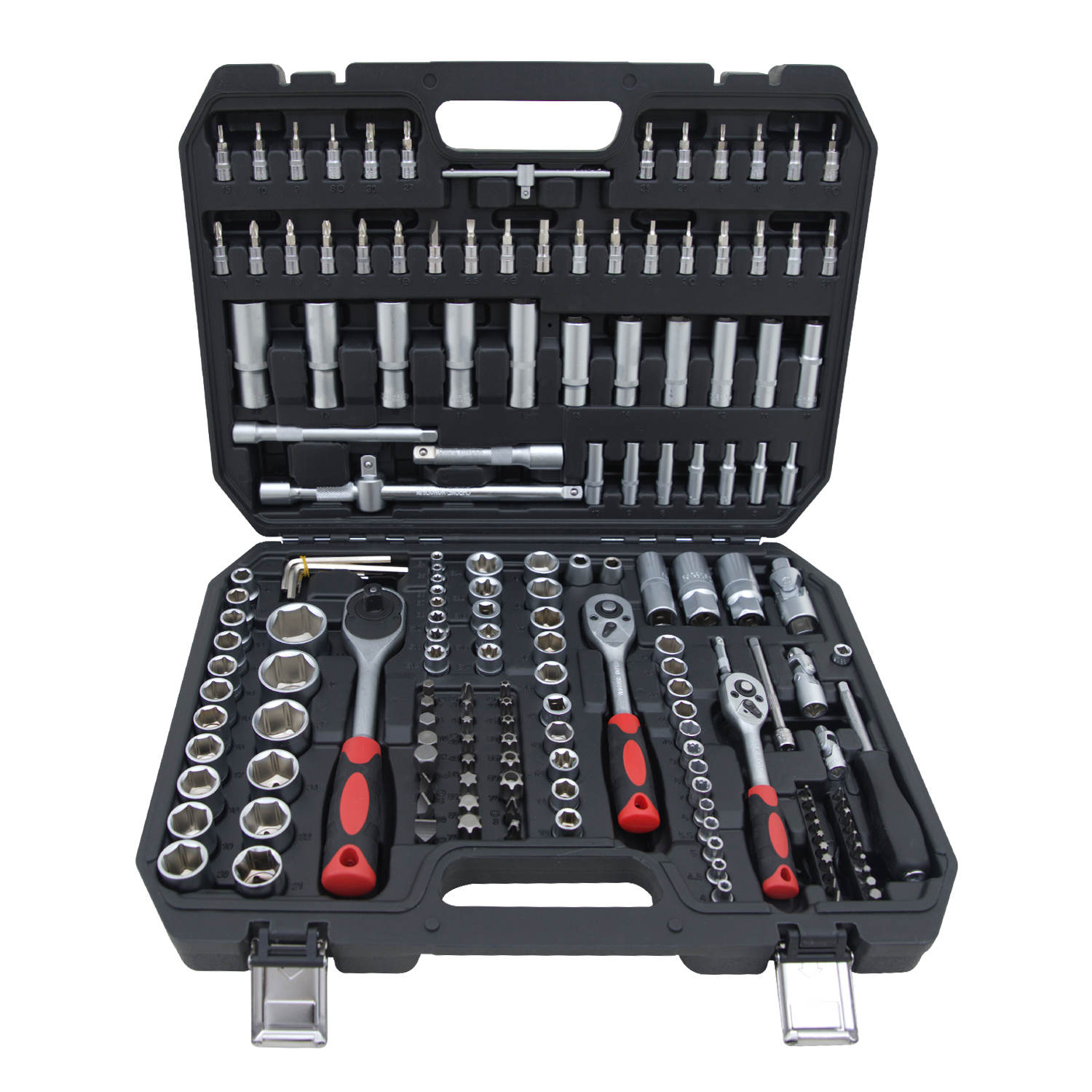
Have you ever spent a frustrating hour trying to turn a single, stubborn bolt behind a heavy home appliance or deep inside a cramped engine bay? It is an incredibly common struggle for field technicians and DIY enthusiasts alike. You quickly realize your standard tool handle simply lacks the room to click to the next gear. This lack of mobility inevitably results in busted knuckles, rounded fasteners, and wasted time. The ultimate problem-solver for these confined workspaces is the fine-tooth ratchet. By significantly reducing the required swing arc, this specialized tool allows for precision and speed where traditional wrenches completely fail. Upgrading your daily loadout to a high-quality socket wrench set equipped with a high-density gear mechanism will drastically change your approach to complex repairs.
Key Takeaways
Swing Arc Magic: Fine-tooth ratchets require as little as 3 to 5 degrees of movement to engage the next gear, compared to the 10 or more degrees needed by older, coarse-tooth models.
Precision in Tight Spots: They are essential for automotive work, HVAC repair, and cramped plumbing spaces where handle mobility is severely limited.
Not All Sets Are Equal: A premium toolkit pairs a high-tooth-count ratchet with low-profile sockets and durable Chrome Vanadium construction for maximum accessibility.
Tool Synergy: While a fine-tooth ratchet is perfect for speed and tight access, pairing it with a portable kit for mobility and a calibrated torque tool for final tightening creates the ultimate mechanical arsenal.
What Exactly is a Fine Tooth Ratchet?
The Anatomy of the Gear Mechanism
At the heart of every ratchet lies a simple yet ingenious mechanism. The pawl and gear wheel work in tandem to drive the socket. As you pull the handle, the pawl locks firmly into the gear teeth. This action transfers your physical force directly to the fastener. A standard coarse ratchet typically relies on 24 to 36 teeth. While robust, this older design requires a wide range of movement to engage the next gear. In stark contrast, a fine-tooth model utilizes a densely packed gear wheel. These wheels feature 72, 90, or even up to 120 tiny teeth. Because there are so many more engagement points, the internal mechanism catches much faster. You can turn the socket with minimal handle movement.
The Math Behind the Swing Arc
The relationship between tooth count and handle movement is purely mathematical. It dictates the specific swing arc required for operation. To calculate this arc, you simply divide a full 360-degree circle by the number of teeth on the gear. A traditional 36-tooth model demands a 10-degree arc just to hear a single click. However, a 72-tooth ratchet requires only 5 degrees of movement. Step up to an ultra-fine 120-tooth tool, and you need a mere 3 degrees. Consequently, smaller arcs allow for superior maneuverability in tightly restricted areas where every millimeter counts.
Why a Fine Tooth Ratchet is the MVP in Tight Spaces
Overcoming Minimal Clearance Restrictions
Modern machinery often packs components tightly together to save space. In a contemporary engine bay, exhaust pipes, cooling fans, and dense wiring harnesses frequently block the physical path of your hands. A coarse-tooth tool might need 10 degrees of swing. If you are working with only 5 degrees of physical clearance, the gear will never engage. You are left completely stuck. A fine-tooth mechanism overcomes this obstacle by allowing continuous rotation even in the most confined scenarios. What was once a nightmare of repetitive tool reseating transforms into a straightforward, manageable task.
Reducing Physical Fatigue and Frustration
Furthermore, removing and re-indexing a socket every few degrees triples the time required for a simple job. This repetitive strain leads to severe hand fatigue. It also increases the likelihood of your tool slipping and causing injury. Fine teeth provide a smooth, continuous ratcheting motion. You can maintain a steady rhythm. This minimizes the need to contort your wrist into awkward, strained positions. Ultimately, you finish the work faster and with significantly less physical toll.
Enhanced Control and Precision
Beyond physical constraints, precision is absolutely critical when threading small, delicate bolts. Finer teeth allow for micro-adjustments. You gain a much better tactile feel for the fastener. This heightened control significantly reduces the risk of cross-threading. Cross-threading is a costly error that frequently occurs when a bolt is forced into a threaded hole at an incorrect angle due to clumsy tool movements.
Coarse Tooth vs. Fine Tooth: Which Do You Need?
The Myth of the Weak Fine Tooth Ratchet
A pervasive misconception among veteran mechanics is that packing more teeth into a gear makes the tool inherently weak. Historically, older metallurgy struggled to support tiny teeth under extreme torque. Modern manufacturing has completely changed the game. Today’s high-quality ratchet wrench set utilizes advanced steel alloys and sophisticated dual-pawl designs. These internal systems engage multiple teeth simultaneously. They effectively distribute the heavy torque load across a much larger surface area. The tool remains highly durable without sacrificing its compact profile.
Feature
Fine Tooth Ratchet (72-120 Teeth)
Coarse Tooth Ratchet (24-36 Teeth)
Swing Arc
3 to 5 degrees
10 to 15 degrees
Best Environment
Tight engine bays, HVAC, under-dash
Heavy agricultural, muddy, high-debris
Torque Distribution
Dual-pawl mechanism spreads load
Single robust pawl
Precision
High micro-adjustment capability
Low tactile feedback
When to Use Coarse Tooth
Are there specific scenarios where coarse teeth are actually superior? Absolutely. In heavy-duty, industrial, or agricultural settings, tools are frequently dropped in mud, sand, or oil-caked debris. In these environments, coarse-tooth ratchets are often the preferred choice. The larger gaps between the teeth are far less likely to become jammed by heavy grit. If your daily work involves constant exposure to harsh external contaminants, a rugged coarse-tooth tool might offer better longevity without requiring constant cleaning.
The Verdict for Modern Mechanics
For the vast majority of automotive, HVAC, and household DIY repairs, the fine-tooth ratchet is objectively superior. Its unparalleled versatility in tight spaces far outweighs the edge-case benefits of coarse gears in high-debris environments. Prioritizing a high-tooth-count system is the smartest way to maximize your daily efficiency.
Industry Trends: The Shift Towards High-Density Gear Mechanisms
As automotive and industrial designs continue to evolve, the demand for highly specialized hand tools is skyrocketing. Manufacturers are consistently downsizing engine blocks. They pack more auxiliary components into tighter spaces to improve fuel efficiency and aerodynamics. This industry-wide trend means the physical working clearance for mechanics is shrinking every single year. Tool engineers are moving away from traditional 36-tooth designs. They focus heavily on developing ultra-fine 90-tooth and 120-tooth mechanisms housed in increasingly slimmer profiles. This shift highlights a broader industry consensus. Precision and accessibility are now just as critical as raw torque when evaluating professional-grade hand tools.
Key Features to Look for in a Premium Tool Collection
Optimal Tooth Count and Material Specifications
Before you make a purchase, always verify the internal gear specifications. You should aim for a tooth count ranging between 72 and 120. Anything below 60 teeth will feel sluggish when you encounter modern, compactly assembled hardware. Additionally, verify that the tools are forged from premium Chrome Vanadium steel. This ensures the internal gear teeth can handle professional-level torque without shearing.
Low-Profile Head and Teardrop Design
A densely packed fine-tooth gear is practically useless if the ratchet head itself is too bulky. Specifically look for a teardrop-shaped head. This specialized shape is engineered to reach deep into narrow channels. A traditional round-headed ratchet would be physically blocked by neighboring brackets or hoses.
Quick-Release Button and Reversible Switch
Working in a blind spot means you often cannot see the fastener you are turning. A flush-mounted reversing lever allows you to switch rotation directions instantly by touch alone. A quick-release button securely locks the socket in place. It prevents the socket from sticking to a greasy bolt upon removal. This is a highly irritating issue when your hand is wedged firmly behind an engine block.
Expanding Your Arsenal: Mobile Solutions and Torque Control
The Value of a Compact Kit
While your primary heavy-duty shop tools should stay organized on the workbench, you still need a mobile solution for unexpected roadside emergencies. A dedicated portable socket set is designed precisely for this kind of on-the-go accessibility. These compact kits usually feature a 1/4-inch drive fine-tooth mini-ratchet. It is significantly smaller and more nimble than a standard 1/2-inch drive model. This makes it an absolute lifesaver for delicate dashboard work or small electronic assemblies.
Knowing When to Switch to Calibrated Measurement
It is vital to remember a fundamental rule of mechanics. A standard ratchet is designed for speed and access, not for accurate measurement. You should never use a regular ratchet to determine the final tightness of a critical bolt. For essential components like cylinder heads, wheel lug nuts, or suspension linkages, you must follow up with a professional torque wrench set. A proper torque wrench ensures you apply the exact clamping force recommended by the manufacturer. This prevents catastrophic failures caused by under-tightening or over-tightening.
Top Real-World Applications
Automotive and Engine Repair
Replacing serpentine belts and extracting spark plugs buried near the firewall are notorious tasks. Adjusting brake caliper bolts also requires extreme patience. In these scenarios, a few degrees of handle movement make all the difference between success and failure.
HVAC and Plumbing Installations
Navigating behind bulky water heaters is a daily challenge for plumbers. Reaching up under cramped bathroom sinks or working inside dark furnace cabinets to adjust burner mounts requires the short swing arc that only ultra-fine teeth can provide.
Industrial Equipment Maintenance
On factory floors, maintaining compact pump systems and hydraulic manifolds demands precise tool maneuvering. High-tooth-count ratchets allow maintenance engineers to swap out valves and tighten flanges without dismantling surrounding pipework.
How to Maintain the Gears
Cleaning and Lubrication
Because fine teeth have much smaller gaps between them, they are inherently more sensitive to internal grit and metal shavings. To keep the mechanism smooth, you should open the ratchet head every six months. Use a safe degreaser to strip away old, gummy oil and accumulated dirt. Once clean, apply a few drops of a light, high-quality machine oil. Avoid heavy greases. Thick lubricants can trap dirt and impede the movement of the tiny pawl springs, causing the gear to slip under pressure.
Proper Storage
Always store your tools in their designated blow-molded case rather than tossing them loosely into a drawer. This simple habit protects the sensitive internal gears from moisture, rust, and ambient shop debris, ensuring your investment lasts for decades.
Conclusion
Ultimately, the defining feature of a fine-tooth ratchet is its minimal swing arc. This single specification separates a frustrating ordeal from a quick, seamless repair job. The tools you choose to wield directly dictate the quality and speed of your work. If you find yourself constantly battling tight clearances, it is time to evaluate your current toolbox. Upgrade to a professional-grade setup with high-tooth-count mechanisms. Keep a portable kit handy for emergencies, and always rely on a calibrated torque tool for final adjustments. For reliable, field-tested equipment that meets these rigorous standards, explore the premium selections at Newstar Hardware to permanently transform the way you tackle complex mechanical challenges.
FAQ
How many teeth is considered a "fine tooth" ratchet?
Generally, any ratchet featuring 72 teeth or more is classified as a fine-tooth model. A 72-tooth gear provides a highly efficient 5-degree swing arc. Premium professional-grade models can feature 90 or even 120 teeth. This reduces the required swing arc to a mere 3 degrees for maximum tight-space maneuverability.
Will a fine tooth ratchet break easier than a coarse tooth one?
Not if you buy a quality tool. Modern fine-tooth ratchets use advanced dual-pawl designs that engage multiple teeth at once. This evenly distributes the load and makes them highly durable under intense pressure.
Can I use a fine tooth ratchet instead of a torque wrench?
No. A fine-tooth ratchet is designed specifically for speed and access in tight spaces. To apply a specific, measured amount of tightness to a fastener, you must use a dedicated torque wrench to avoid damaging the components.
What is the best drive size for tight spaces?
A 1/4-inch or 3/8-inch drive is usually best for tight clearances. A 1/2-inch drive is significantly bulkier and better suited for heavy-duty suspension or lug nut work where physical space is less restricted.
Do I need to lubricate my fine tooth ratchet?
Yes. Periodic maintenance with a light machine oil keeps the fine teeth engaging smoothly and prevents premature wear. You should avoid heavy greases that can trap dirt and impede the internal springs.
Why does my ratchet slip under heavy load?
Ratchet slipping usually occurs when internal pawl springs are worn out or when thick, contaminated grease prevents the teeth from fully engaging. Cleaning the mechanism and applying light machine oil often resolves this issue. If the teeth are physically sheared, the tool must be replaced.
Are teardrop ratchet heads better than round heads?
Yes, for tight spaces. Teardrop heads have a slimmer, tapered profile that slides easily into narrow gaps. Round heads are generally bulkier because they house a different style of reversing mechanism, making them less ideal for cramped engine bays.