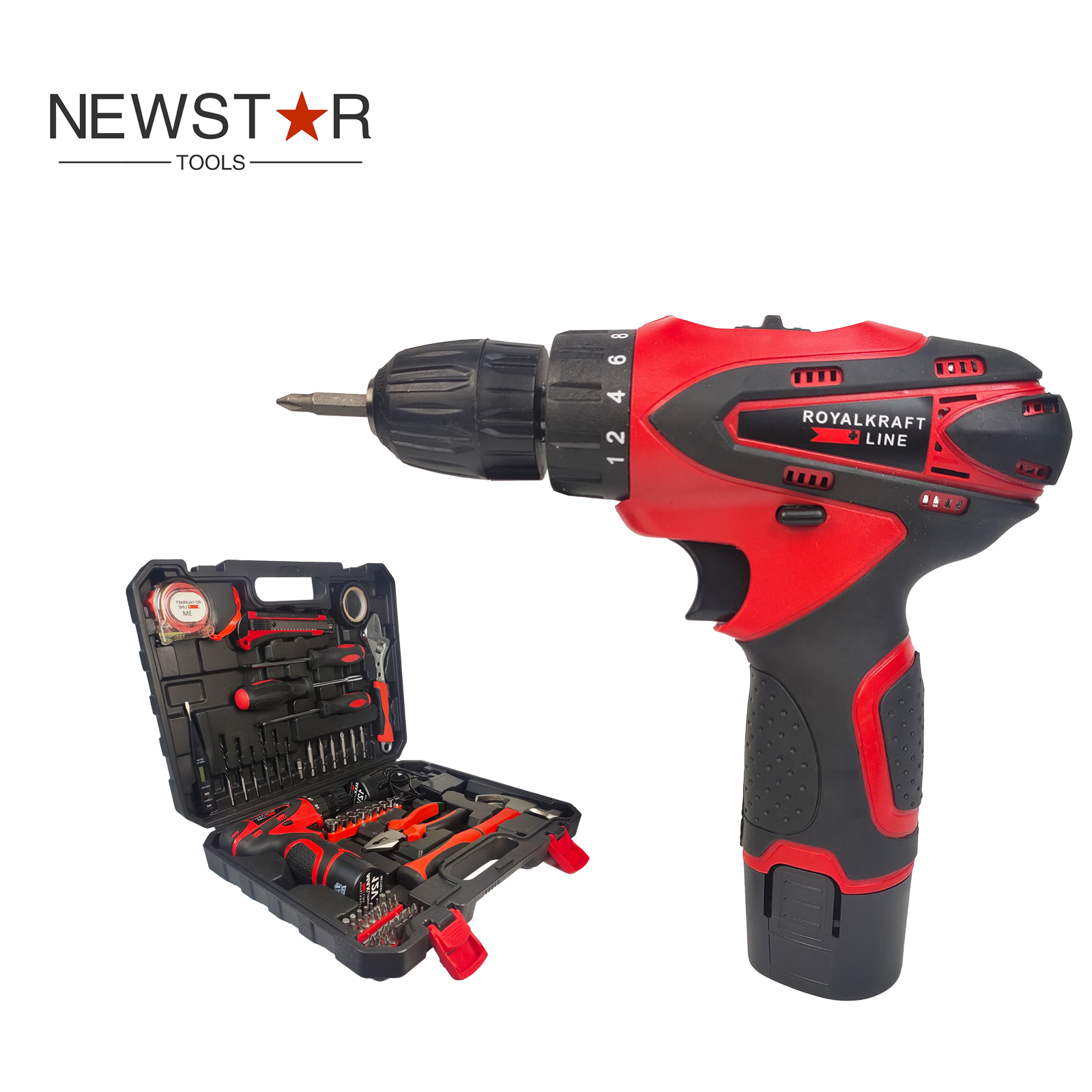
Light-duty construction and assembly projects often fail right at the fastening stage. Users frequently apply too much torque, causing stripped screws, cracked plastic housings, and damaged materials. Conversely, using a tool with too little power results in stalled motors, stripped screw heads, and incomplete drilling. Buyers struggle to identify the exact threshold where an electric screwdriver's convenience is outweighed by the necessity of a fully featured 12V Cordless Drill Tool Kit. This confusion leads to redundant purchases or compromised project quality on larger tasks.
Choosing the right fastening tool requires looking past marketing claims and understanding the mechanical limits of the hardware. We must establish a technical evaluation framework that compares these two tool categories. By analyzing motor specifications, chuck mechanisms, torque control, and long-term utility, you can determine which investment aligns with your specific project demands.
- Primary Distinction: Electric screwdrivers prioritize precision, compactness, and low-RPM control for pre-threaded or light fastening, whereas a 12V cordless drill offers the necessary RPM and torque for boring holes and driving into raw materials.
- Versatility vs. Specialization: A 12V cordless drill is a multi-functional baseline tool; an electric screwdriver is a specialized secondary tool for high-volume, low-torque repetitive tasks.
- Form Factor Constraints: Electric screwdrivers excel in confined spaces (e.g., cabinetry, electronics) due to inline or articulating designs, while 12V drills require more clearance due to the pistol-grip and adjustable clutch assembly.
- Investment Logic: Purchasing a comprehensive 12V cordless drill tool kit generally yields a higher return on investment for generalists, while professionals often adopt electric screwdrivers to supplement heavier 18V/20V platforms.
Defining the Contenders: Core Mechanics and Success Criteria
The Anatomy of an Electric Screwdriver
Electric screwdrivers operate within a specific, narrow performance band designed for precision over raw power. Standard specifications typically range from 4V to 8V, though some 12V models exist on the market for slightly heavier applications. They deliver low rotational speeds, generally between 150 and 400 RPM. Torque output remains intentionally low, often capping under 50 in-lbs. This restricted power profile prevents damage to delicate components, making them ideal for electronics and pre-threaded machine screws.
The drive mechanism relies on a standard 1/4-inch hex collet. This design requires specific hex-shank bits, limiting accessory compatibility compared to traditional chucks but allowing for rapid bit changes. Form factors vary to accommodate different access needs. You will find inline straight models, articulating bendable designs, and compact pistol grips. These shapes allow users to navigate tight enclosures easily, such as computer cases or deep cabinet corners.
When evaluating these tools on the job site, you quickly realize their limitations. They lack the internal gearing required to push through resistance. If you hit a knot in a piece of pine, the motor will simply stop. This is a protective feature for the tool, but a hindrance if you are trying to complete structural work.
The Anatomy of a 12V Cordless Drill
A 12V cordless drill represents a significant step up in mechanical capability. Standard specifications include higher RPM, often featuring dual-speed gearboxes capable of hitting 1,300 RPM or more in the high-speed setting. Torque delivery is substantially higher, ranging from 150 to over 300 in-lbs. This power allows the tool to bore through dense materials efficiently, from dimensional lumber to light-gauge steel.
The drive mechanism utilizes an adjustable keyless chuck, typically 3/8-inch in capacity. This chuck accepts round, hex, and specialized shanks, offering vast accessory compatibility. A critical component is the mechanical clutch. The clutch assembly prevents over-driving by disengaging the motor from the drive shaft once a pre-set torque limit is reached. This protects both the fastener and the work surface, giving the user granular control over the driving depth.
Internally, these drills feature robust planetary gear systems. These gears multiply the motor's torque, allowing a relatively small 12V motor to perform heavy-duty tasks. The inclusion of a variable speed trigger means you can feather the power, starting a hole slowly before ramping up to full speed to clear the debris.
![12V Cordless Drill Tool Kit vs Electric Screwdriver]()
Feature-to-Outcome Evaluation: 12V Cordless Drill Tool Kit vs. Electric Screwdriver
Torque Delivery and Material Limitations
Fastening capabilities differ drastically between the two tools. Electric screwdrivers handle machine screws, cabinet hinges, and flat-pack furniture assembly perfectly. They excel where threads already exist. In contrast, 12V drills dominate when driving wood screws into wall studs or dense materials. The drill generates the rotational force necessary to cut new threads into raw wood or composite.
Heavy-duty limits clearly separate the categories. A 12V drill is required for high-resistance tasks. Driving long lag bolts or mixing paint and drywall mud demands sustained torque. Attempting these tasks with an electric screwdriver will instantly stall the motor. However, evaluating the risk of cam-out reveals a distinct advantage for the screwdriver. The low speed of a cordless screwdriver kit prevents stripping delicate brass hardware or small-gauge screws during installation.
| Feature | Electric Screwdriver | 12V Cordless Drill |
| Max Torque | Under 50 in-lbs | 150 - 300+ in-lbs |
| RPM Range | 150 - 400 RPM | 0 - 1,300+ RPM |
| Chuck Type | 1/4-inch Hex Collet | 3/8-inch Keyless Chuck |
| Primary Use | Pre-threaded fastening | Drilling and heavy driving |
Speed (RPM) and Drilling Viability
RPM matters significantly for drilling operations. Wood, metal, and plastic require high-speed rotation to clear debris from the hole and cut cleanly. Slow rotation causes tear-out in wood and binding in metal. High RPM ensures the cutting edges of the bit slice through the material rather than tearing it.
Electric screwdrivers are fundamentally inadequate for primary drilling applications. Their low RPM cannot clear material fast enough. Furthermore, the lack of a traditional chuck means bits wobble, leading to inaccurate holes. If you need to drill holes regularly, an electric screwdriver will only cause frustration.
When you use a drill on high speed, the flutes of the drill bit act as an auger, pulling wood chips or metal shavings out of the hole. If the RPM drops too low, this clearing action stops. The bit gets packed with debris, friction increases, and the bit overheats. This ruins the temper of the steel bit and burns the wood.
Chuck Types and Bit Compatibility
The versatility of a compact drill set lies primarily in its chuck. The 3/8-inch keyless chuck grips almost any accessory. It allows for brad point bits, twist drills, hole saws within a reasonable diameter, and standard driver bits. You are not restricted to a single shank style.
Conversely, the 1/4-inch hex drive on a screwdriver imposes strict limitations. It requires specialized hex-shank drill bits if drilling is attempted. This requirement adds hidden costs, as you must purchase a separate set of hex-compatible drill bits rather than using standard round-shank bits you may already own.
Ergonomics, Weight, and Spatial Access
User fatigue plays a major role in tool selection. Electric screwdrivers are significantly lighter than drills. This weight reduction minimizes wrist strain during repetitive tasks like switchplate installation or computer assembly. You can use an electric screwdriver for hours with minimal discomfort.
Spatial access also favors the smaller tool. Inline screwdrivers can reach deep recesses inside appliances or engine bays. The bulky motor housing and battery pack of a 12V drill often obstruct access in these confined areas. When clearance is measured in millimeters, the electric screwdriver is the only viable option.
Application Mapping: Which Tool Fits Your Workload?
Ideal Scenarios for Light Duty Power Tools (Electric Screwdrivers)
Specific tasks benefit immensely from light duty power tools. These scenarios prioritize control over raw power.
- PC building, electronics repair, and delicate appliance maintenance.
- High-volume flat-pack furniture assembly, such as IKEA products.
- HVAC technicians and electricians performing repetitive, low-torque terminal and panel work.
- Installing cabinet hardware where over-tightening will crack the wood finish.
- Working inside vehicle dashboards where a full-sized drill cannot fit.
Ideal Scenarios for a DIY Drill Kit (12V Cordless Drills) on Bigger Projects
When projects scale up, a DIY drill kit becomes indispensable. The 12V platform handles structural work effectively.
- General home maintenance and larger DIY projects, including hanging heavy shelving, mounting TVs, and installing drywall anchors.
- Light woodworking and cabinetry, specifically pre-drilling pilot holes and driving fasteners into hardwood.
- Projects requiring mixed materials, such as drilling through light gauge metal, plastics, and dimensional lumber.
- Using wire wheels or sanding drums for surface preparation.
- Driving self-tapping screws into aluminum extrusions.
Scalability and Ecosystem Value (Conceptual Trade-offs)
Battery Platforms and Upgradability
Entry-level electric screwdrivers often feature internal, non-removable batteries. This creates a severe limitation. When the internal battery degrades over time, the entire tool dies and must be discarded. You cannot swap a fresh battery in to keep working.
Investing in a 12V drill from a major brand offers a distinct advantage. Batteries can be shared across a vast ecosystem. You can power specialized trade tools like oscillating tools, impact drivers, right-angle ratchets, and inspection cameras using the same batteries. Buying a drill kit can serve as a highly economical entry point. This battery hack strategy allows you to acquire premium batteries and chargers for a broader tool ecosystem at a lower combined cost.
Removable batteries also allow for continuous workflow. You can keep one battery on the charger while using the other. With internal batteries, once the tool dies, your project stops for several hours while it recharges.
Cost-to-Utility Ratio and the "Frequency of Use" Myth
A common myth suggests a screwdriver is used more often because of daily household quick-fixes. However, analyzing the mechanics reveals a different truth. A 12V drill can perform 100% of a screwdriver's tasks simply by lowering the clutch setting and using a light trigger pull. A screwdriver can only perform a fraction of a drill's tasks.
Compare the upfront cost of a premium screwdriver against an entry-level 12V drill set. The prices are often remarkably similar. For users who only intend to own one power tool, the 12V drill offers exponentially more utility per dollar spent. It prevents you from hitting a hard performance ceiling halfway through a project.
Implementation Risks and Mitigation
Risk of Material Damage (Over-Torquing)
Using a 12V drill on delicate electronics or soft plastics introduces significant risk. The torque can shatter plastic housings or strip fine machine threads instantly. To mitigate this risk, you must properly utilize the drill's mechanical clutch. Setting the clutch to 1 or 2 limits the torque output. Relying on the variable speed trigger for slow rotation also helps. If the material is exceptionally fragile, defaulting to an electric screwdriver is the safest choice.
When working with brass screws, the risk is even higher. Brass is soft and shears easily under high torque. Always pre-drill the hole to the exact root diameter of the screw, and use a hand screwdriver or a low-torque electric screwdriver for the final seating.
Motor Burnout and Tool Abuse
Attempting to drive 3-inch deck screws or drill large diameter holes with an electric screwdriver will result in a motor stall. Repeated stalling causes rapid heat buildup and eventual motor burnout. Mitigation requires strictly adhering to the manufacturer's intended use cases. You must recognize when a task requires the gear reduction and sustained power of a 12V drill. Do not force a light-duty tool to perform heavy-duty work.
Listen to the tool. If the motor pitch drops significantly and the tool struggles to turn, you are exceeding its capacity. Stop immediately, back the fastener out, and switch to a more powerful drill.
Conclusion
The choice between these tools is about matching the tool's mechanical limits to the scale and scope of your projects. Understanding torque, RPM, and chuck mechanisms ensures you buy the right tool for the job. Choose an electric screwdriver if you already own an 18V/20V drill and need a lightweight, precision companion for assembly, electronics, and rapid, low-fatigue fastening. Choose a 12V cordless drill tool kit if you are buying your first or only power tool, as it handles both heavy drilling and delicate driving effectively.
- Audit your upcoming projects to determine your true torque and drilling requirements before making a purchase.
- Evaluate preferred battery ecosystems to avoid buying into dead-end platforms with non-removable batteries.
- Check for comprehensive kits that include the tool, interchangeable batteries, and a versatile bit set to maximize initial value.
- Test the ergonomics of the tool in person to ensure the grip and weight distribution feel comfortable for extended use.
FAQ
Q: Can I use an electric screwdriver to drill holes in wood?
A: While possible using specific hex-shank drill bits, it is highly inefficient. The low RPM causes tear-out, and the lack of torque makes it prone to stalling. Continuous drilling will severely tax the small motor, potentially leading to premature failure.
Q: Is a 12V cordless drill powerful enough for home use?
A: Yes. A 12V drill is more than sufficient for 90% of standard household tasks. It easily handles drilling into drywall, wood, and light gauge metal, as well as driving standard fasteners for furniture and shelving.
Q: What is the difference between an electric screwdriver and an impact driver?
A: Impact drivers use internal hammers to deliver rotational strikes, creating massive torque for driving large, stubborn fasteners. Electric screwdrivers apply smooth, continuous, low-torque rotation designed specifically for delicate work and pre-threaded holes.
Q: Do I need a cordless screwdriver kit if I already own a drill?
A: It depends on your workflow. A screwdriver kit serves as an excellent fatigue-reducing, precision secondary tool. It is particularly useful for light-duty tasks in hard-to-reach spaces where a standard drill is too bulky or heavy.
Q: Why do some 12V cordless drill tool kits come with two batteries?
A: Two batteries provide a crucial workflow advantage. You can operate the tool continuously by using one battery while the depleted one charges. This eliminates downtime and is essential for uninterrupted progress on larger DIY projects.