Disorganized tools and inadequate storage create hidden operational costs in high-volume or professional workshops. Lost billable hours, misplaced specialty equipment, and premature wear on precision instruments directly impact productivity. Upgrading to a high-capacity 12 drawer tool cabinet requires balancing physical floor footprint, dynamic load ratings, and long-term capital investment. Purchasing the wrong system results in either overpaying for unnecessary industrial-grade overhead or under-buying on structural integrity. This leads to warped frames, sagging slides, and dangerous tipping hazards. A systematic, engineering-focused framework is necessary for evaluating a storage system based on usable interior volume, steel gauge specifications, physical mechanical reliability, and environmental resilience.
- Usable volume dictates actual value: Total footprint is deceptive; a 24-inch depth cabinet provides up to 37% more functional volume than a standard 18-inch depth model, directly affecting long-tool storage capabilities.
- Weight capacity is a structural indicator: Look beyond static weight limits. High-performance steel workshop cabinets require a minimum of 100-lb ball-bearing slide ratings on single drawers and 200-lb dual-slide ratings on deep drawers to handle heavy impact tools.
- Safety and transport require over-engineering: A fully loaded 12 drawer rolling tool cabinet demands heavy-duty, dual-locking polyurethane casters and active latching mechanisms to prevent accidental drawer rollouts during transit.
- Environmental protection extends lifespans: Double-wall steel construction combined with chemical-resistant powder coatings and secure tubular locks protect high-value tool assets from both shop floor environment degradation and physical theft.
Defining Success Criteria for a 12 Drawer Tool Cabinet
Assessing Project Workflows and Tool Inventory
A thorough audit of existing tools determines the ideal mix of drawer heights and widths. You cannot select a storage system without knowing exactly what you need to store. Categorize your inventory into hand tools, heavy power tools, and sensitive diagnostic equipment. Hand tools require shallow drawers for quick access and visual inventory checks. Power tools, blow-molded cases, and heavy pullers need deep, reinforced bottom drawers.
Customizing the cabinet choice based on the target workshop environment dictates the final specification. An automotive diagnostic bay relies heavily on electronic scanners, multimeters, and specialized testing leads, requiring padded, shallow storage. A heavy fabrication shop needs massive weight capacity for grinders, welding clamps, and heavy hammers. A carpentry studio prioritizes long, wide drawers for hand saws, planes, and measuring tools.
Always plan for a 20-30% volume expansion to ensure the cabinet scales with future tool acquisitions. Buying a cabinet that is already 100% full on day one guarantees you will need secondary storage within months. Anticipating growth keeps the workspace organized and prevents tools from piling up on work surfaces.
- Empty all current tool boxes and lay everything out on workbenches.
- Group tools by category: sockets, wrenches, screwdrivers, power tools, specialty kits.
- Measure the longest tools (like 36-inch pry bars or long torque wrenches) to determine minimum drawer width and depth.
- Weigh the heaviest categories (like 3/4-inch drive socket sets) to establish required slide load ratings.
Footprint vs. Usable Drawer Volume (The Depth Reality)
The technical comparison between standard 18-inch and heavy-duty 24-inch depth cabinet profiles reveals significant differences in usable space. Total footprint is often deceptive. An 18-inch cabinet depth yields only about 16 inches of usable drawer depth because of the rear frame structure and the locking mechanism clearance. Conversely, a 24-inch profile yields approximately 22 inches of usable length.
This extra depth is the benchmark for storing long pry bars, torque wrenches, and bulky blow-molded cases. When you factor in the width of the cabinet, that extra 6 inches of depth translates to a massive increase in total cubic inches of storage. It allows you to store wrenches front-to-back rather than side-to-side, freeing up horizontal space for more tool sets.
| Cabinet Depth Profile | Usable Drawer Depth | Volume Increase (vs 18-inch) | Ideal Storage Application |
| Standard 18-inch | ~16 inches | Baseline | Basic hand tools, compact cases, small garages |
| Intermediate 21-inch | ~19 inches | +18% | General automotive repair, mixed tool sets |
| Heavy-Duty 24-inch | ~22 inches | +37% | Long pry bars, torque wrenches, large power tools |
Modular Customization and Accessory Integration
High-density drawer liners play a necessary role in preserving steel surfaces and preventing tool sliding. Bare steel drawers will scratch immediately, leading to rust. Liners protect both the tools and the cabinet from impact damage when dropping heavy ratchets into place. Closed-cell foam liners resist oil and chemicals better than cheap rubber mats.
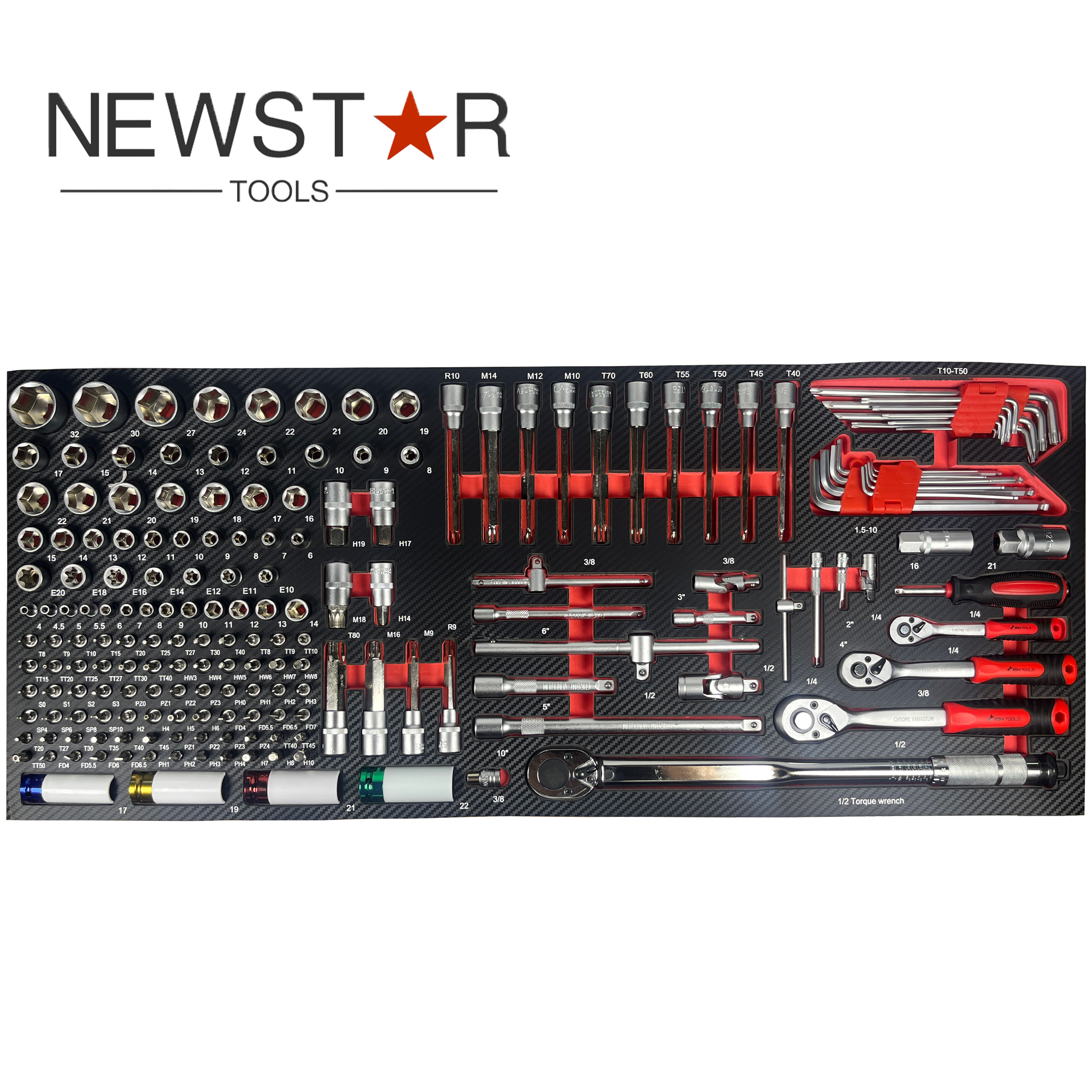
Evaluating drawer customization options maximizes layout efficiency. Magnetic socket trays, adjustable steel dividers, and modular organizer systems keep tools securely in place. When you open a drawer quickly, you do not want sockets rolling to the back. Custom foam cutouts offer the highest level of organization, providing a specific pocket for every single tool, which makes missing items instantly obvious.
Core Evaluation Dimensions: Construction and Mechanics
Steel Gauge and Frame Structural Integrity
Deciphering sheet metal thickness is the first step in evaluating structural integrity. A lower gauge steel workshop cabinet, such as 18-gauge (approximately 1.2mm thick), is structurally superior to thin consumer-grade models, which are often 21-gauge (approximately 0.8mm thick). The lower the gauge number, the thicker the steel. Thicker steel prevents the cabinet frame from twisting when loaded with thousands of pounds of tools.
The structural impact of frame engineering dictates long-term survival on the shop floor. Double-wall steel construction with heavy spot welds resists torsional stress far better than single-wall construction held together with seam rivets. When you push a fully loaded cabinet across an uneven concrete floor, a riveted single-wall frame will flex, causing drawers to bind. A welded double-wall frame remains rigid.
Drawer Slide Ratings, Detent Systems, and Extension Mechanics
Industrial ball-bearing drawer slides outperform basic friction slides in durability and load capacity. Friction slides bind and scrape when loaded with heavy tools. A baseline rating of 100-lbs per drawer is necessary for professional use. Require 200+ lbs dual-slide configurations for deep bottom drawers holding heavy sockets, jacks, or power tools. Dual slides distribute the weight, preventing the drawer from sagging when fully extended.
Mechanical latching options prevent drawers from drifting open when moving the cabinet. Raise-and-release latches integrated into the drawer pull are far superior to simple friction detent systems. Detents wear out over time, allowing drawers to fly open if you hit a bump while rolling the cabinet. Full-extension slides are a functional necessity over partial-extension configurations. They allow the drawer to pull out completely, eliminating blind spots at the rear and giving you full access to every tool.
Caster Specifications for Mobile Tool Storage
Caster wheel materials significantly affect the performance of mobile tool storage. Polyurethane offers a lower coefficient of rolling resistance over uneven, oil-slicked, or debris-strewn concrete compared to phenolic resins or hard rubber. Hard rubber flat-spots over time, and phenolic wheels can chip on concrete expansion joints. Polyurethane absorbs minor impacts while rolling smoothly.
Ensure casters on a 12 drawer rolling tool cabinet are rated for 1.5x the maximum loaded weight of the cabinet. This requires a minimum combined caster rating of 1,200 to 2,000+ lbs. Total-lock casters, which simultaneously lock wheel rotation and swivel axis pivot, provide a safety advantage over basic wheel tread locks. If the swivel is not locked, the cabinet can still shift and pivot while you are working out of it.
![12 Drawer Tool Cabinet Construction]()
Categorizing Your Options: Consumer, Prosumer, and OEM Tool Cabinets
Consumer-Grade Garage Tool Cabinets
Consumer-grade garage tool cabinets typically feature thinner-gauge steel (20-22 gauge) and single-wall frames. They have lower caster weight thresholds, often maxing out around 500 lbs total capacity. The drawer slides are usually rated for 50 lbs or less, and the locking mechanisms are basic flat-key cam locks that offer minimal security.
The primary use case for these cabinets includes residential garage applications, light DIY automotive maintenance, and storing lightweight hand tools. They are not built to withstand daily abuse, heavy impacts, or exposure to harsh shop chemicals. Pushing them across rough concrete will quickly loosen the frame rivets.
Prosumer & Professional-Grade Cabinets
Prosumer and professional-grade cabinets utilize double-wall steel frames (16-18 gauge) and structural reinforcement ribs. They often include integrated power strips for charging tool batteries and high-security tubular lock barrels. The casters are heavy-duty polyurethane, and the drawer slides are rated for 100-200 lbs.
These cabinets are designed for commercial auto repair bays, heavy machining shops, and daily-use industrial environments. They can handle the weight of massive socket sets and heavy power tools without sagging. The powder-coated finishes resist brake fluid and solvents.
OEM Tool Cabinet Solutions
An OEM tool cabinet offers standardized specifications and modular drawer configurations tailored to specific industry needs. They provide factory customization options, such as specific color matching, custom drawer layouts, and verified replacement parts availability. If a slide breaks five years down the line, you can easily source an exact replacement.
The primary use case encompasses fleet maintenance operations, specialized manufacturing plants, and high-end workshops demanding uniform tool storage systems. OEM solutions ensure that every technician in a large facility has the exact same storage capability, streamlining operations and tool inventory management.
Value-Influencing Factors and Conceptual Trade-offs
Drawer Configuration and Layout Efficiency
Analyzing the standard 12-drawer split involves evaluating the ratio of shallow drawers to deep drawers. Shallow drawers (typically 2 to 3 inches deep) are ideal for wrenches, pliers, screwdrivers, and shallow sockets. Deep drawers (6 to 10 inches deep) accommodate power tool storage, bulky cases, and large hammers.
The design trade-off centers on having many shallow drawers for maximized organizational layout versus fewer, deeper drawers to hold larger equipment. A cabinet with mostly shallow drawers forces you to store power tools elsewhere. A cabinet with too many deep drawers wastes vertical space when storing low-profile hand tools. The ideal 12-drawer layout usually features a full-width top drawer for long tools, a bank of shallow drawers on one side, and a mix of medium and deep drawers on the other.
Security Systems and Lock Mechanics
Heavy-duty tubular lock cylinders provide superior security compared to internal flat-key cam locks. Flat-key locks can often be picked or forced open with a heavy screwdriver. Tubular locks offer much higher resistance to tampering. The internal locking mechanism also matters. Look for thick steel locking bars that engage the back of every drawer simultaneously.
Advanced physical security features are required in multi-user commercial environments. Tamper-resistant locking bars and digital electronic keypad access control offer enhanced protection for valuable tool inventories. Keypad access eliminates the problem of lost keys and allows shop managers to track who accessed the cabinet and when.
Environmental Resistance and Finish Durability
Electrostatic powder-coated finishes offer greater durability than liquid paint finishes. Powder coating is baked onto the steel, creating a thick, hard shell that resists chipping and scratching. Liquid paint chips easily when struck by a heavy wrench, exposing the bare steel to moisture.
Evaluate the cabinet's resilience against chemical exposure. In a shop environment, the cabinet will inevitably be exposed to brake fluid, parts washer solvents, and motor oil. A high-quality powder coat will not soften or peel when wiped down with harsh chemicals. High-humidity oxidation and physical impact chipping are significant threats, making a robust finish essential for long-term survival.
Implementation Risks and Safety Mitigations
Tipping Hazards and Center of Gravity Engineering
Understanding the physics of a loaded tool cabinet prevents dangerous tipping hazards. A fully loaded cabinet can weigh over 2,000 lbs. If you open multiple heavy drawers near the top, the center of gravity shifts forward, and the entire cabinet can tip over, causing severe injury or death.
The heaviest equipment must sit in the lowest drawer slots to keep the center of gravity low. Store heavy impact sockets, iron clamps, and large power tools at the very bottom. Integrated anti-tip mechanisms physically lock the remaining eleven drawers when one drawer is fully extended. This mechanical interlock system is a non-negotiable safety feature in professional environments.
Routine Preventive Maintenance Protocols
Establish procedures for maintaining the mechanical components of the cabinet. Neglecting maintenance leads to bound slides and seized casters. Dirt, metal shavings, and grinding dust will eventually work their way into the ball bearings.
- Empty the drawers and wipe down the slide tracks with a clean rag to remove old, contaminated grease.
- Apply a light coat of white lithium grease to the ball bearings. Avoid heavy automotive grease, as it attracts too much dust. Dry graphite is an alternative in very dusty environments like woodworking shops.
- Cycle the drawer open and closed several times to distribute the lubricant evenly.
- Inspect caster swivel bearings and apply grease via the zerk fittings every six months.
- Check the frame welds and drawer bottoms for signs of fatigue or sagging under heavy loads.
Conclusion
- Measure the clear floor space in your physical workspace, accounting for the depth of the cabinet plus the clearance needed to fully extend the deepest drawers.
- Calculate your current tool weight metrics to determine the required dynamic slide and caster load ratings before making a selection.
- Verify the manufacturer's specifications for steel gauge, ensuring a minimum of 18-gauge for the main frame and double-wall construction.
- Map out your tool inventory against the proposed drawer configuration to confirm you have the correct ratio of shallow to deep storage.
FAQ
Q: What is the standard depth of a 12 drawer tool cabinet?
A: Standard depths are typically 18 inches, but heavy-duty professional models feature a 24-inch depth. The 24-inch depth provides significantly more usable drawer space for longer tools like pry bars and torque wrenches.
Q: How much weight should a steel workshop cabinet drawer hold?
A: A professional-grade drawer should hold a minimum of 100 lbs on single ball-bearing slides. Deep drawers intended for heavy power tools should utilize dual-slide configurations rated for 200 lbs or more.
Q: What is the difference between an 18-gauge and a 21-gauge steel cabinet?
A: An 18-gauge steel cabinet is thicker (approx. 1.2mm) and structurally stronger, suitable for professional environments. A 21-gauge cabinet is thinner (approx. 0.8mm) and typically found in light-duty consumer models.
Q: What drawer latching style is best for a 12 drawer rolling tool cabinet?
A: Active latching mechanisms, such as raise-and-release latches, are best. They securely hold drawers closed during transit, preventing accidental rollouts far better than standard friction detent systems.
Q: How does the climate or humidity in a garage tool cabinet impact steel selection?
A: High humidity accelerates oxidation and rust on bare steel. Selecting a cabinet with double-wall construction and a high-quality, chemical-resistant electrostatic powder-coated finish mitigates these environmental risks.
Q: Can I replace or upgrade the casters on my mobile tool storage system?
A: Yes, casters can often be upgraded. Ensure the replacement casters match the mounting plate bolt pattern and offer a combined dynamic load rating of at least 1.5x the cabinet's maximum loaded weight.
Q: How do I arrange a 12-drawer tool cabinet to optimize accessibility and safety?
A: Store the heaviest tools in the bottom deep drawers to maintain a low center of gravity and prevent tipping. Place frequently used hand tools in the upper, shallower drawers for quick visual access.