A sudden engine stall on a desolate highway at midnight tests more than just your nerves. It exposes the exact level of your mechanical preparedness. Stranded on the shoulder of a dark road, the clock ticks relentlessly. The wait for a dispatch vehicle often stretches into hours. Surprisingly, countless drivers face these high-stakes moments completely unequipped. They either lack proper gear entirely or rely on flimsy metal that strips at the first sign of resistance.
High-quality hand tool sets serve as the ultimate frontline defense against roadside breakdowns. Having the correct instruments empowers you to execute minor repairs safely and efficiently. You can get your vehicle back on the asphalt in minutes. This comprehensive guide breaks down the critical advantages of carrying a dedicated kit. We will explore the most common repairs you can tackle, the essential gear required, and how to evaluate different equipment grades for your trunk.
Key Takeaways
Immediate Problem Solving: Professional-grade gear empowers drivers to fix common roadside issues like flat tires, dead batteries, and loose battery terminals immediately.
Safety and Efficiency: Utilizing an organized kit reduces stress and saves crucial time during high-pressure roadside emergencies.
Right Tool for the Job: Indoor collections work for basic fixes, but specialized automotive kits provide the sheer torque and precise fittings required for reliable vehicle maintenance.
Preventative Preparedness: Inspecting and maintaining your trunk equipment before long road trips is just as important as checking your engine oil.
Recent automotive aftermarket data reveals a fascinating shift in driver behavior. The average age of passenger vehicles on the road has hit record highs. Concurrently, professional towing and emergency labor costs have surged significantly. Industry analysts note a massive spike in consumer demand for professional-grade, portable repair kits. Modern motorists are actively ditching cheap emergency bags. They are upgrading to heavy-duty toolsets that provide genuine mechanical leverage. This trend highlights a broader cultural return to vehicle self-sufficiency. Even with today's complex electronic control units, cars still suffer from fundamental mechanical failures. Traditional, reliable metal tools remain the only way to fix a blown hose or a dead battery terminal on the spot.
The Invaluable Benefits of Keeping Hand Tool Sets in Your Car
Cost and Time Savings
Minor mechanical hiccups require only a few minutes to rectify. A disconnected vacuum hose or a corroded battery terminal is an easy fix with the right leverage. Addressing these small tasks independently bypasses exorbitant emergency towing fees. Furthermore, taking matters into your own hands eliminates the agonizing hours spent waiting for a dispatch vehicle to arrive.
Enhanced Roadside Safety
Sitting idle on the edge of a busy interstate is inherently hazardous. Every passing semi-truck serves as a stark reminder of the danger. Getting your engine running rapidly minimizes your exposure to fast-moving traffic. A well-equipped kit allows you to execute rapid fixes. This directly reduces the statistical probability of a secondary collision and keeps you out of harm's way.
Self-Reliance During Road Trips
Modern adventures frequently take us through remote rural backroads. Cellular service often drops to zero in these areas. Calling for help simply is not an option. Carrying dependable gear fosters a deep sense of self-reliance. A simple loose bolt will never derail a carefully planned journey when you have the right wrench on hand.
Common Roadside Vehicle Maintenance Tasks You Can DIY
Changing a Flat Tire
A blowout is the most frequent roadside emergency. Most sedans come with a rudimentary tire iron. However, comprehensive kits offer vastly superior alternatives. A high-leverage lug wrench or a breaker bar provides the necessary torque to safely loosen over-tightened lug nuts. This ensures the vehicle remains stable on the jack while you mount the spare securely.
Battery Maintenance and Jump-Starting
Extreme temperatures trigger sudden battery failure. Before jumper cables can work, the terminals must establish a rock-solid electrical connection. Combination wrenches and wire brushes allow you to scrape away acidic buildup and tighten loose terminal clamps. A clean connection is vital for transferring the amperage needed to crank a dead engine block.
Replacing Blown Fuses and Bulbs
Electrical anomalies frequently trace back to a solitary blown fuse. Replacing these tiny components requires precision. Needle-nose pliers are perfect for extracting recessed blade fuses from a cramped engine bay box. Similarly, accessing headlight housings usually demands standard screwdrivers to carefully pry away retaining clips without cracking the plastic.
Tightening Loose Clamps and Hoses
Constant engine vibrations cause hose clamps to back out over time. This leads to sudden coolant leaks and catastrophic overheating. A standard socket set equipped with an extension allows you to reach deep into the engine bay. Re-tightening worm-gear clamps secures a leaking radiator hose temporarily. This simple action can save your engine block and allow you to limp safely to a service station.
Essential Components of a Mobile Workshop Tool Set for Cars
Socket and Ratchet Sets
The undeniable backbone of any automotive repair kit is a robust socket collection. Modern vehicles utilize a confusing mixture of metric and standard SAE fasteners. A dual-measurement set is mandatory. Specifically, a high-tooth-count ratchet is critical. A 72-tooth mechanism provides a tight 5-degree swing arc. This allows you to turn bolts in highly restricted, knuckle-busting spaces.
Wrenches
Ratchets cannot squeeze into every tight crevice. Combination wrenches are indispensable for tackling brake lines and battery terminals. They feature an open end for quick turning and a closed box end for high-torque applications. An adjustable wrench serves as a versatile backup for odd-sized fittings. You must use it cautiously to avoid rounding off stubborn bolt heads.
Screwdrivers and Pliers
No automotive kit is complete without diverse screwdrivers and pliers. Flathead and Phillips variants pry interior panels and open electrical housings. Locking pliers can firmly grip stripped bolts. Slip-joint and needle-nose pliers excel at manipulating wires and compressing spring-style hose clamps.
Specialty Automotive Add-ons
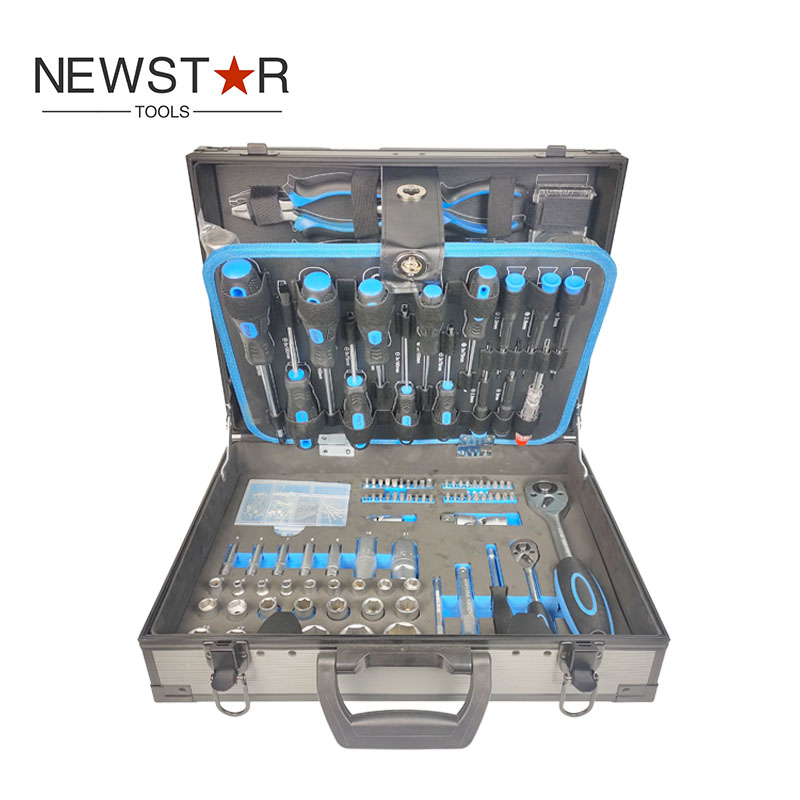
Elevating a basic kit to professional standards requires specific implements. Spark plug sockets with rubber inserts protect delicate ceramic insulators. For drivers seeking maximum preparedness, investing in a comprehensive mobile workshop tool set is a game-changer. These 177-piece professional setups provide heavy-duty Chrome Vanadium construction, specialized add-ons, and the precise torque capabilities needed for complex on-the-go repairs.
Household Hand Tool Set vs. Specialized Automotive Kits
The Limits of Indoor Gear
It is tempting to grab tools from your garage drawer. However, a standard household hand tool set is engineered for residential tasks like assembling flat-pack furniture. These kits contain carbon steel components, a claw hammer, and lightweight pliers. They severely lack the heavy-duty sockets and torque tolerance required to break loose rusted automotive bolts. Using indoor tools on car parts frequently results in stripped fasteners and shattered metal.
The Power of Specialized Automotive Tools
Automotive-specific kits are forged to survive harsh environments. They are typically crafted from high-grade Chrome Vanadium steel. This material undergoes specialized heat treatments to withstand immense twisting forces. Furthermore, these implements feature advanced anti-corrosive finishes to resist degradation from brake fluid and winter road salt.
Motorists who prefer not to haul a massive mechanic chest can opt for a heavy-duty hybrid collection. These kits prioritize metric sockets and robust pliers over woodworking gear. This ensures the driver has the leverage needed for emergency fixes without sacrificing cargo space.
Why an Organized Hand Tool Set is Crucial in High-Stress Situations
Speed and Accessibility
Roadside breakdowns rarely happen on sunny afternoons. They usually occur in the pouring rain. Fumbling blindly through a canvas bag of loose metal wastes precious time. An organized hand tool set featuring a molded hard case allows you to instantly locate the exact 10 millimeter socket required. This drastically accelerates the repair process.
Preventing Lost Tools
Working on the shoulder of a dark road means gear can easily vanish into tall grass. A meticulously organized blow-molded case acts as an instant visual checklist. Designated slots make it blatantly obvious if a pair of pliers is missing before you slam the hood shut. This prevents the catastrophic mistake of leaving a wrench resting near moving engine belts.
Vehicle Safety While Driving
Loose heavy metal objects in a trunk pose a severe safety hazard. In the event of a panic stop, free-floating ratchets transform into deadly projectiles. Securely latched cases keep all components locked firmly in place. This ensures the safety of the vehicle occupants during transit.
Practical Application During a Breakdown
Using a Torque Wrench for Lug Nuts
After mounting a spare tire, you must tighten the lug nuts to exact specifications. Over-tightening warps brake rotors. Under-tightening may result in the wheel detaching at highway speeds. Set the torque wrench dial to the specified foot-pounds. Tighten the nuts in a crisscross star pattern until you feel the audible click.
Operating a Ratchet in Tight Spaces
Today's engine bays are densely packed mazes. Utilize extension bars and universal swivel joints. An extension bar lengthens your reach past obstructing components. A swivel allows the socket to engage a bolt at an awkward angle. Always ensure the socket is fully seated to prevent rounding the bolt edges.
Safe Pliers Usage for Hoses
Replacing a blown radiator hose demands manipulating stubborn constant-tension spring clamps. Standard pliers easily slip off these metal tabs. Adjust slip-joint pliers to the precise width. Even better, use locking pliers to compress the tabs securely. Slide the metal ring away from the fitting before gently twisting the hose to break the seal.
Caring for Your Equipment
Rust Prevention and Cleaning
Car trunks experience brutal temperature fluctuations. Condensation can rapidly rust untreated metal. Wipe off any grease, coolant, or road grime with a clean rag after every use. Applying a very light coat of machine oil creates a protective barrier against oxidation.
The Pre-Trip Checklist
A kit is completely useless if it is missing crucial pieces. Perform a thorough inspection before embarking on a cross-country road trip. Verify that all sockets are present. Ensure ratchets engage smoothly without skipping teeth. Check that pliers open without binding. This preventative habit guarantees you will not discover a missing jack handle when you are already stranded.
Proper Storage Solutions
Avoid leaving the case sliding around the main cabin. The optimal storage location is in the trunk, secured under the cargo floor alongside the spare tire. Utilize cargo nets to strap the hard case to anchor points if under-floor storage is unavailable. This prevents impact damage and maintains a quiet ride.
Conclusion
Carrying reliable gear is a fundamental pillar of responsible vehicle ownership. The stark difference between fumbling helplessly with a basic indoor kit and confidently managing an emergency with a properly organized, heavy-duty collection cannot be overstated. When the unexpected happens, having the right leverage transforms a potential disaster into a minor inconvenience. Take a moment today to evaluate your current trunk emergency setup. Upgrading to a professional, comprehensive tool set from trusted manufacturers like Newstar Hardware ensures you remain safe, self-reliant, and fully prepared for whatever the road throws your way. Explore their extensive catalog to find the exact kit that matches your vehicle's demands.
FAQ
Q1: Can I just use my household hand tool set for my car?
You can utilize them for very minor cosmetic issues, such as tightening a loose interior screw or a license plate frame. However, household kits severely lack the specific deep sockets, heavy-duty wrenches, and overall structural durability required to handle automotive bolts and high-torque applications without breaking.
Q2: What are the most important tools to have in a roadside emergency kit?
At a bare minimum, your roadside arsenal should include a comprehensive metric and standard socket set, an adjustable wrench, heavy-duty jumper cables, locking and needle-nose pliers, a multi-bit screwdriver, and a high-lumen tactical flashlight for nighttime visibility.
Q3: How do I keep my hand tool sets from rusting in my car trunk?
To combat trunk moisture, keep your gear securely stored in a sealed, organized hard case. Tossing a few silica gel packets into the box works wonders to absorb ambient humidity. Additionally, make it a habit to occasionally wipe down the metal surfaces with a moisture-displacing lubricant or a light machine oil.
Q4: What is the difference between a standard tool kit and a mobile workshop tool set?
A mobile workshop is highly comprehensive, often featuring well over a hundred pieces. It boasts heavy-duty construction and includes specialty automotive instruments like torque wrenches, spark plug sockets, and breaker bars. These are specifically designed to handle complex, high-stress mechanical repairs on the go.
Q5: How often should I check my vehicle's tool set?
It is considered best practice to inspect your tools before every major road trip. If you do not travel long distances frequently, check the kit at least twice a year during your routine seasonal vehicle inspections to ensure absolutely nothing is missing, rusted, or damaged.
Q6: Will extreme winter temperatures damage the tools stored in my trunk?
High-quality Chrome Vanadium steel tools are generally unaffected by freezing temperatures. However, extreme cold can make plastic handles brittle and cause condensation when the metal warms up. It is best to keep your gear in a sealed hard case and wipe them down with a moisture-displacing lubricant before winter hits.
Q7: Do I need both metric and standard sockets for a modern vehicle?
Yes. While the vast majority of modern cars manufactured globally use metric fasteners, you will frequently encounter aftermarket parts, battery terminals, or older accessories that utilize standard SAE sizing. Carrying a dual-measurement set ensures you are never caught off guard by an incompatible bolt head.