Engine bays are notoriously unforgiving environments. Mechanics constantly battle tight clearances, seized components, and the ever-present threat of fluid leaks. Managing radiator hoses, fuel lines, and their corresponding clamps is a daily mechanical hurdle. Without the correct mechanical advantage, these routine tasks quickly escalate into hand fatigue, damaged rubber lines, or severe knuckle injuries. Specialized holding tools transform this workflow. High-quality pliers do more than just grip. They improve workshop safety, reduce labor time, and ensure a professional-grade finish for every fluid system repair.
Recent automotive engineering trends heavily influence tool requirements across the industry. Modern vehicle architectures prioritize compact packaging, leaving minimal room for conventional hand tools. Furthermore, the rapid transition toward hybrid and fully electric drivetrains introduces high-voltage risks right next to traditional cooling circuits. Industry data shows a significant shift in workshop equipment procurement. Technicians are moving away from generic slip-joint tools. Instead, there is a surging demand for purpose-built, ergonomically optimized, and electrically insulated holding tools designed specifically to handle complex hose routing safely.
Precision Holding Tools: The Foundation of Engine Care
Automotive fluid transfer systems present unique mechanical challenges. Components endure extreme thermal cycling and harsh chemical exposure. Consequently, rubber and silicone hoses inevitably vulcanize, bonding tightly to their metal or plastic fittings. Applying generic tools to these fused connections is a recipe for disaster. Standard pliers lack the optimized jaw geometry required for circular clamping. This mismatch causes uneven pressure distribution, which easily scratches delicate aluminum fittings or punctures soft coolant hoses.
Professional technicians recognize the value of precision-engineered instruments. As vehicle complexity scales up, minimizing repetitive strain injury is crucial for daily operations. Upgrading your toolbox with purpose-built equipment multiplies grip strength. It distributes force evenly across the clamp surface. Why risk micro-leaks in a newly serviced cooling system? The right tool prevents the distortion that typically causes these frustrating comebacks.
Navigating Clamp Types and Mechanical Strategy
Before applying any force, a technician must evaluate the specific fastener securing the line. Automotive manufacturers deploy a vast array of clamp designs. You will encounter constant tension spring clamps, traditional worm-gear drives, and single-use ear-style fasteners. The choice depends entirely on the pressure and temperature demands of that specific fluid path. Attacking these fasteners with the wrong profile guarantees component distortion.
Understanding these mechanical differences dictates your tool selection. Constant tension clamps demand grooved or slotted jaws to capture the metal tabs securely. In contrast, ear-style clamps require specialized pincers for proper crimping. Matching the jaw profile to the fastener ensures a lock-tight grip. This strategic approach prevents high-tension springs from dangerously snapping loose during removal.
Heavy-Duty Work: Leveraging Adjustable Mechanisms
Large-diameter systems, like lower radiator hoses or heavy-duty intercooler piping, demand massive leverage and wide-jaw capacity. These applications require a tool that adapts instantly to varying pipe diameters while maintaining a relentless grip on oxidized connections.
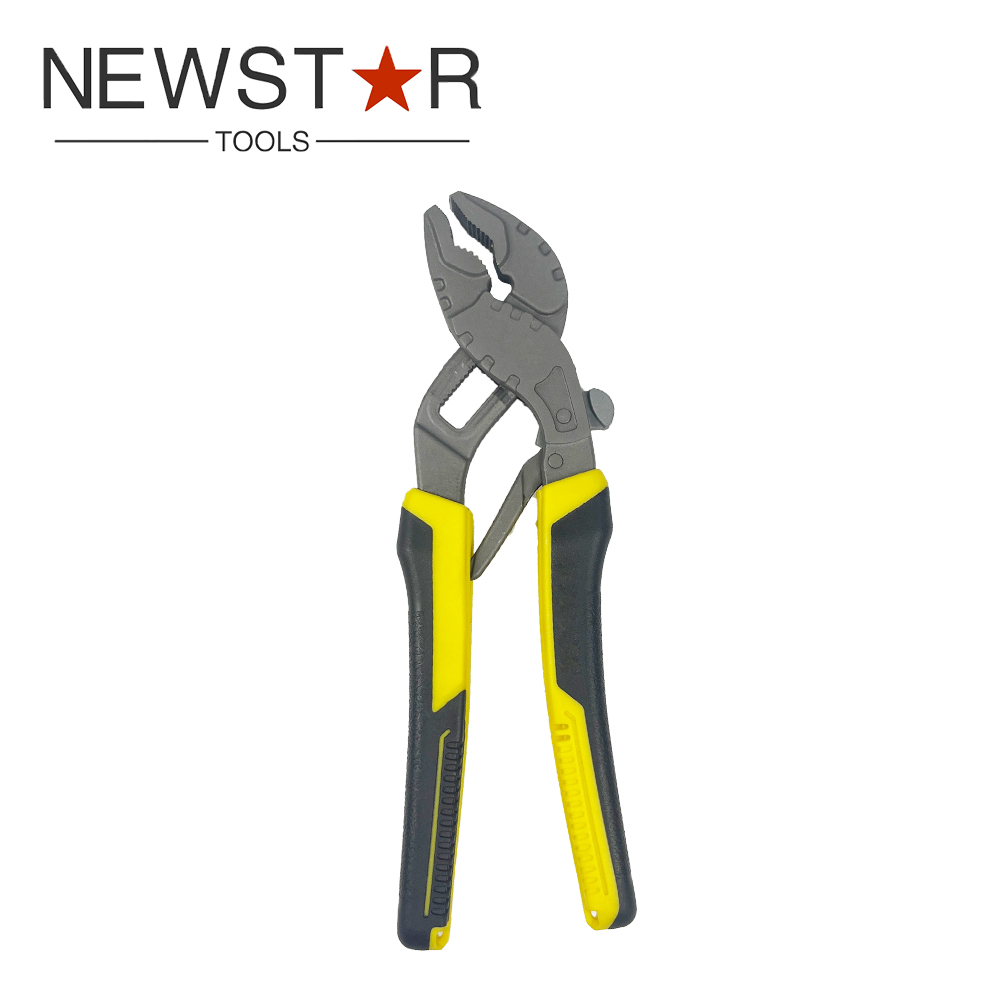
In these high-torque scenarios, heavy-duty water pump pliers are an engineer's best asset. Industrial-grade models feature a robust adjustable pivot mechanism and are forged from premium Chrome Vanadium steel for maximum durability. The multi-groove design allows the jaws to open wide while keeping the handle ergonomics intact. When a stubborn radiator hose is thermally bonded to a thermostat housing, you can leverage these deeply serrated jaws to apply a controlled rotational twist. This breaks the seal effectively, completely avoiding the brute force that frequently shatters expensive plastic radiator necks.
Tight Clearance Precision with Specialized Profiles
While heavy-duty adjustable tools dominate the primary cooling circuits, modern engine blocks hide a labyrinth of smaller vacuum lines and fuel returns. These critical components are often buried beneath intake manifolds or wedged tightly against the firewall. Bulky tools simply cannot access these micro-environments.
This is where the elongated, tapered jaw design of 8.7-inch long nose pliers becomes indispensable. The extended reach allows technicians to bypass obstacles and access recessed areas with surgical precision. Specifically, multi-function variants integrate high-leverage wire-cutting blades near the pivot. This streamlined design allows you to snip securing zip ties, pull deep-seated vacuum hoses, and trim excess rubber without constantly switching between different hand tools.
The proliferation of electrified vehicles fundamentally alters automotive repair protocols. Mechanics frequently route cooling hoses adjacent to high-voltage battery packs and complex wiring harnesses. A single accidental electrical short can destroy a sensitive Engine Control Unit or cause severe personal injury.
Adopting a certified VDE pliers set is no longer optional; it is a strict safety mandate. Professional VDE tools undergo rigorous dielectric testing to withstand up to 1000 volts. If a technician accidentally bridges a live terminal while wrestling with a heater core hose, the insulated handles block the current path. Beyond electrical protection, these specialized sets feature bi-material, anti-slip grips. Even when covered in slippery coolant or synthetic oil, the tool remains firmly in your hand, drastically reducing fatigue-related slippage.
Core Tool Selection Matrix for Hose Management
To eliminate guesswork on the shop floor, we have standardized the tool selection process. Review the matrix below to match the exact hardware to your specific automotive application.
Tool Category
Key Engineering Specs
Primary Automotive Application
Engineered Advantage
Adjustable Water Pump Pliers
CR-V Steel, Multi-groove pivot, Deep serrations
Radiator hoses, intercooler pipes, large spring clamps
Maximum torque application without crushing plastic fittings.
Multi-Function Long Nose Pliers
8.7-inch reach, Integrated cutting edge, Tapered tip
Vacuum lines, fuel returns, firewall clearances
Bypasses engine block obstacles for surgical micro-adjustments.
Guarantees technician safety against high-voltage shorts.
Expert Techniques for Safe Hose Removal
Extracting older, vulcanized rubber requires immense patience and the right technique. A rookie mistake is attempting to pull the line straight off the barb. This almost always tears the inner liner or snaps the fragile fitting. Instead, seasoned mechanics rely on the twist-and-pull method.
First, slide the tension clamp well away from the connection point. Next, apply your holding tool gently around the rubber, positioned just above the barb. Apply firm, even pressure and introduce a slight rotational twist. This twisting action safely shears the thermal bond. For severely stubborn connections, carefully sliding a curved pick tool under the lip before twisting will break the vacuum seal without distorting the underlying metal.
Tool Maintenance and Longevity
Professional holding tools are significant workshop investments. Given the corrosive nature of engine fluids, a strict maintenance routine guarantees a lifetime of reliable service. After completing a job, aggressively wipe away coolant, oil, and road grime with a heavy-duty shop towel.
Inspect the jaw serrations regularly. A quick scrub with a brass-bristled brush removes embedded debris that causes slippage under load. Finally, apply a drop of high-quality machine oil to the pivot joints to ensure buttery-smooth operation. Always store insulated safety gear in a dry, climate-controlled environment to prevent oxidation and protect the critical dielectric coatings.
Conclusion
Mastering automotive fluid systems is an exercise in leverage and precision, not brute force. Integrating the correct holding tools into your daily workflow completely transforms the repair experience. High-capacity adjustable jaws conquer stubborn primary hoses. Extended reach profiles navigate tight firewall clearances. Insulated safety sets protect against modern high-voltage hazards. Equipping your shop with these purpose-built instruments safeguards vehicle integrity and technician safety.
Are you ready to upgrade your mechanical efficiency? Explore the professional-grade solutions at Newstar Hardware. From heavy-duty adjustable tools to certified insulated sets, selecting the right equipment ensures your next automotive project is safe, efficient, and entirely leak-free.
Frequently Asked Questions
Q: Can I use regular pliers instead of specialized hose holding tools?
While standard pliers might work in an emergency, they lack the optimized jaw geometry to grip clamps securely. This leads to severe slipping and component damage. Dedicated holding tools are engineered to grip circular or spring-loaded objects firmly without crushing them, effectively preventing the clamp from springing loose during installation.
Q: What is the benefit of a VDE pliers set for general automotive work?
VDE-rated tools are heavily insulated to protect you from electrical shock. As modern vehicles incorporate complex electronic control units and high-voltage hybrid systems, having an insulated set adds a non-negotiable layer of safety when working near dense wiring harnesses or battery components.
Q: How do I choose between water pump pliers and long nose pliers?
You must select your tool based on spatial constraints and torque requirements. Utilize water pump pliers for large-diameter hoses, stubborn thermostat fittings, and high-leverage tasks. Conversely, reach for long nose models when you need to fine-tune connections, navigate deep engine crevices, or manipulate smaller vacuum lines.
Q: Should I use a lubricant when removing old hoses?
Yes, applying a small amount of silicone-based dielectric spray helps loosen a bonded hose. However, strictly avoid petroleum-based penetrants as they rapidly degrade EPDM rubber. The most effective technique combines a light silicone lubricant with the twist-and-pull method to break the thermal seal safely.
Q: What is the most effective tool for removing a seized radiator hose?
For a seized radiator hose, heavy-duty adjustable pliers with deeply serrated jaws are the most effective. The wide jaw capacity allows you to grip the hose securely over the fitting. By applying a gentle twisting motion rather than pulling directly, you can break the vulcanized bond without cracking the plastic radiator neck.
Q: Why do automotive holding tools feature different jaw textures?
Jaw textures are engineered for specific grip profiles. Deep, aggressive serrations are designed to bite into thick rubber hoses and metal pipes for maximum rotational torque. Meanwhile, fine-toothed or smooth jaws are used for delicate spring clamps and soft vacuum lines to prevent surface punctures and material fatigue.