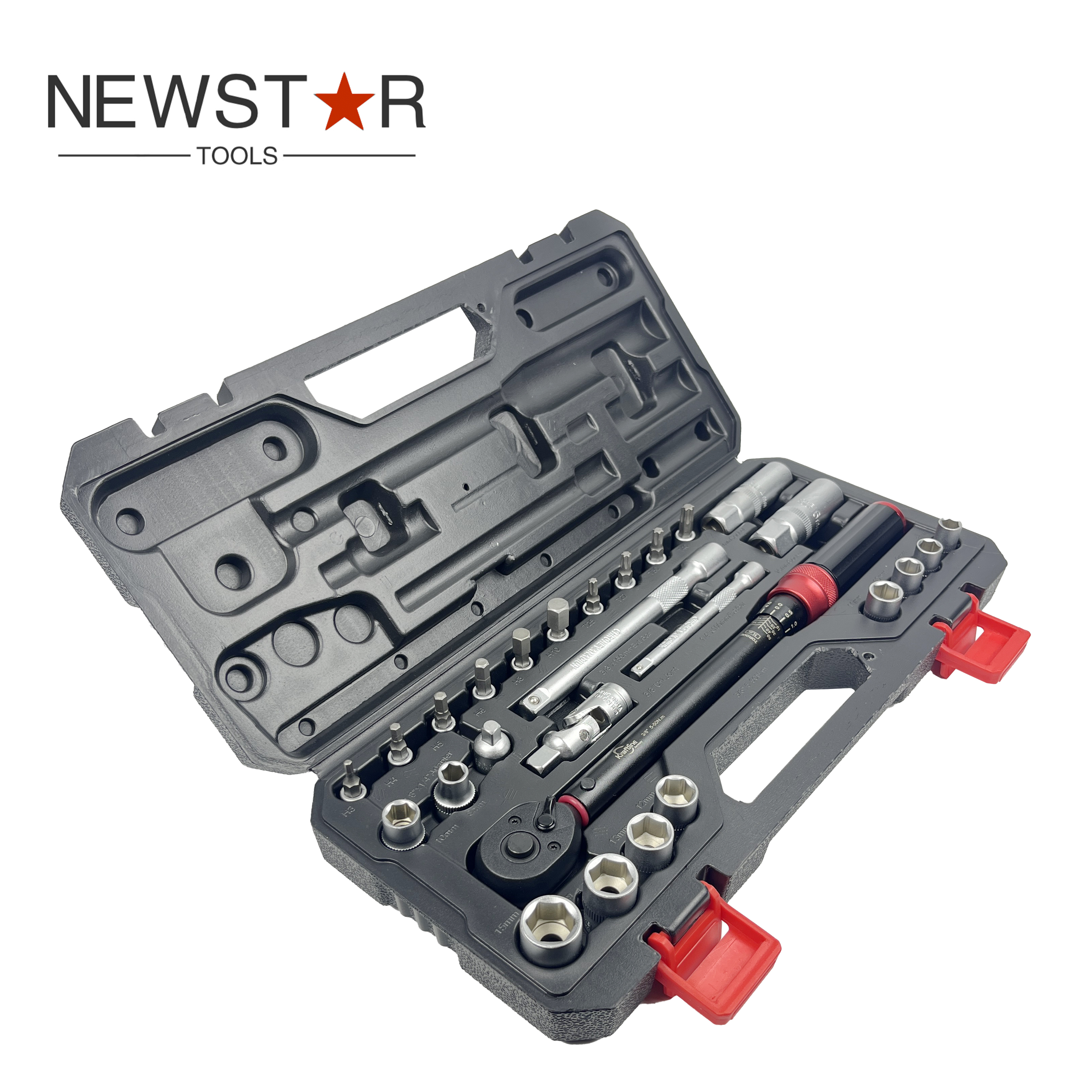
Improper fastener tension in automotive repair carries severe mechanical and financial consequences. A single over-tightened lug nut can warp brake rotors, causing violent steering wheel shake during deceleration. A loose cylinder head bolt leads to blown head gaskets and compromised engine compression. In extreme cases, incorrect torque results in catastrophic wheel detachment while driving at highway speeds. The market is currently saturated with cheap, uncalibrated tools that drift out of spec quickly. This leaves mechanics and serious DIYers guessing on critical torque values instead of knowing them with absolute certainty.
You need a reliable way to ensure every bolt meets factory specifications. A systematic approach to selecting your tools eliminates the guesswork. We will introduce a framework for evaluating and selecting a Torque Wrench Set based on drive size, mechanism type, accuracy standards, performance tiers, and long-term maintenance requirements. Understanding these factors guarantees you apply the exact clamping force required for safe, professional-grade repairs.
- Match Drive Size to Application: A complete set covers the necessary spectrum—1/2-inch for heavy suspension and lugs, 3/8-inch for engine bays, and 1/4-inch for delicate sensors.
- Prioritize Certified Accuracy: Look for tools with a documented accuracy rating of at least ±4% clockwise, backed by an ISO or ASME calibration certificate.
- Respect the 20/100 Rule: Torque wrenches are most accurate in the middle 80% of their scale; buying a multi-piece torque wrench kit prevents pushing a single wrench to its extreme limits.
- Factor in Frequency of Use: Professional mechanics require robust, highly durable mechanisms (like split-beam or digital) to withstand daily shop abuse, while weekend DIYers may find high-quality click-type adjustable torque wrenches more cost-effective.
- Assess the Ecosystem: A proper automotive torque tool setup requires specialized accessories, including thin-walled non-marring sockets for alloy wheels and premium extension bars.
The Cost of Inaccuracy: Why Your Automotive Torque Tool Matters
Success Criteria for Fastener Tension
Automotive bolts function exactly like heavy-duty springs. When you tighten a fastener, you stretch the metal shaft. This stretch creates the clamping force holding two components together. Engineers design every bolt to reach a specific yield point. If you fail to reach this point, the connection remains loose. If you exceed it, the bolt deforms permanently and loses its structural integrity.
Under-torquing introduces severe risks to the vehicle. Engine vibrations easily cause loose bolts to back out over time. This leads to fluid leaks at gaskets, exhaust blow-by, and structural failure in suspension components. A loose control arm bolt will alter alignment geometry and destroy tires in a matter of days. Conversely, over-torquing is equally destructive. Applying excessive force strips delicate aluminum threads in engine blocks, requiring time-consuming helicoil repairs. It warps mating surfaces and shears bolt heads entirely, leaving the threaded shaft stuck in the block. A reliable automotive torque tool prevents these failures. The baseline requirement for any mechanic torque wrench is repeatable, verifiable accuracy over thousands of tightening cycles.
To understand the mechanics of clamping force, consider the cylinder head installation process. Head bolts must compress a multi-layer steel gasket evenly across the entire engine block surface. If one bolt is torqued to 60 ft-lbs and the adjacent bolt is torqued to 85 ft-lbs, the cylinder head will warp. Combustion gases will breach the gasket seal, pushing coolant out of the radiator and overheating the engine. This single error turns a standard repair into a complete engine replacement. Precision is not optional; it is the foundation of mechanical reliability.
Evaluating Torque Wrench Mechanisms: Which Type Fits Your Workflow?
Click-Type (Adjustable Torque Wrench)
The click-type mechanism remains the most common design in automotive shops. It utilizes an internal spring and a pivoting pawl system. When you reach the target torque, the pawl slips. This action produces a distinct mechanical "click" you can feel and hear. An adjustable torque wrench of this type is highly practical for general automotive work.
- Pros: They are widely available and easy to source. The tactile feedback is excellent for noisy shop environments where air compressors and impact guns drown out digital beeps. You feel the release in the handle immediately.
- Cons: The internal spring is susceptible to metal fatigue over time. You must manually dial the handle back to its lowest setting after every single use to maintain calibration. Forgetting this step will ruin the tool's accuracy within a few weeks.
Split-Beam
Split-beam wrenches measure torque through the physical deflection of a primary beam against a secondary stationary beam. This design eliminates the heavy internal coil spring found in click-type models. You set the target torque using a small dial, and a mechanical indicator snaps when you reach the desired tension.
- Pros: You do not need to zero out the wrench after use. You can leave it set to 100 ft-lbs for wheel lugs indefinitely. They are incredibly durable and hold their factory calibration significantly longer than spring-loaded alternatives.
- Cons: The mechanism requires a bulkier head design. This makes them difficult to maneuver in tight engine bays, such as between the firewall and the rear cylinder bank on a transverse V6. Most split-beam models only measure torque in the clockwise direction.
Digital / Electronic
Digital wrenches represent the pinnacle of fastening precision. They use internal strain gauges to measure applied force. A digital screen displays the exact torque value in real-time. They often provide audible beeps, LED light progressions, and haptic handle vibrations as you approach the target value.
- Pros: They offer the highest level of accuracy, often within ±2%. Many modern units include torque-plus-angle measurement capabilities. This is absolutely essential for modern torque-to-yield engine bolts, which require a specific torque value followed by a precise degree of rotation (e.g., 40 ft-lbs + 90 degrees).
- Cons: They rely on batteries to function. A dead battery stops your workflow immediately. The delicate electronics make them fragile if dropped on a concrete shop floor. They also require a higher initial investment and careful storage away from extreme temperatures.
| Mechanism Type | Primary Advantage | Primary Disadvantage | Best Use Case |
| Click-Type | Tactile feedback in noisy shops | Requires zeroing after every use | General maintenance, suspension work |
| Split-Beam | Holds calibration without zeroing | Bulky head design limits access | Repetitive tasks like wheel installations |
| Digital | Torque-plus-angle capabilities | Fragile and battery-dependent | Engine building, internal transmission repair |
![Mechanic using a torque wrench on a car wheel]()
Sizing Your Torque Wrench Set: Drive Sizes and Working Ranges
1/4-Inch Drive (Precision & Interior)
The smallest drive size handles delicate automotive work. The ideal range typically spans 20 to 200 in-lbs (2 to 22 Nm). You will use this drive size for mass airflow sensors, plastic thermostat housings, valve body bolts, and transmission pan bolts. Modern vehicles use extensive plastic components under the hood. A 1/4-inch drive is necessary for preventing the cracking of these brittle plastic housings. When tightening a 10mm bolt on a plastic intake manifold, a larger wrench lacks the sensitivity required to feel the fastener seat properly.
3/8-Inch Drive (General Engine & Drivetrain)
The 3/8-inch drive serves as the primary workhorse in most toolboxes. The ideal working range falls between 15 and 100 ft-lbs (20 to 135 Nm). Common automotive use cases include spark plugs, oil drain plugs, intake manifolds, and valve covers. When evaluating this size, look for a compact ratcheting head. You need maximum clearance to navigate tight spaces around the firewall and engine block. A flex-head option on a 3/8-inch drive is highly recommended for reaching spark plugs on modern V-configuration engines.
1/2-Inch Drive (Heavy-Duty & Suspension)
Heavy-duty tasks demand a 1/2-inch drive. The standard range covers 30 to 250 ft-lbs (40 to 340 Nm). You need this tool for lug nuts, axle nuts, brake caliper brackets, and major suspension control arms. The tool must feature a long handle, typically 18 to 24 inches. Adequate length provides the necessary leverage to reach high torque values without causing user strain or back injury. Attempting to pull 150 ft-lbs on a short-handled wrench will result in jerky, inaccurate movements.
3/4-Inch and 1-Inch Drives (Heavy-Duty Trucks & Commercial Vehicles)
Commercial applications require massive force. These drives typically handle ranges from 100 to over 600 ft-lbs (135 to 800+ Nm). Use cases include commercial diesel trucks, agricultural tractors, and heavy-duty harmonic balancers. Manufacturers usually sell these as standalone tools rather than in standard consumer kits. Operating them requires substantial physical strength or the addition of mechanical torque multipliers. These wrenches often exceed 40 inches in length to provide adequate mechanical advantage.
The Car Wheel Torque Benchmark
Passenger car and SUV wheel specifications provide a perfect benchmark for tool selection. Most standard vehicles require between 80 and 140 Nm (approximately 60 to 100 ft-lbs) of torque for their lug nuts. A wrench with a broader, mid-scale range, such as 30 to 210 Nm, is optimal for wheel applications. This specific range keeps the target wheel torque value perfectly centered within the tool's peak accuracy band. Using a 3/8-inch wrench maxed out at 100 ft-lbs for wheel lugs will quickly degrade its internal spring.
Why a Torque Wrench Kit is Superior to a Single Tool
Professionals adhere strictly to the "20% to 100% rule." A torque wrench is generally only accurate within the top 80% of its stated scale. The bottom 20% is notoriously unreliable. Investing in a dedicated torque wrench kit ensures you always operate in the middle, most accurate portion of the tool's scale. A kit prevents you from maxing out a smaller wrench or barely engaging the spring on a larger one.
- Identify the torque specification in your service manual.
- Select the wrench from your kit where the target value falls near the middle of the scale.
- Verify the drive size matches the socket required for the fastener.
- Adjust the tool to the exact specification, locking the handle securely.
- Apply smooth, even pressure until the mechanism indicates the target is reached.
Key Evaluation Dimensions for a Mechanic Torque Wrench
Certified Accuracy and Calibration Standards
Never trust a tool without documentation. Buyers must look for strict compliance with recognized industry standards, such as ISO 6789 or ASME B107.300. Emphasize the importance of a factory calibration certificate. This document must contain the actual, hand-signed test data from the factory floor, showing the tested values at 20%, 60%, and 100% of the scale. A generic pass/fail stamp printed on the box is insufficient for serious automotive work. If the tool does not include a serialized certificate matching the number stamped on the handle, reject it.
Frequency of Use and Duty Cycle
Your daily workflow dictates the required durability. The occasional DIYer focuses on value and simple weekend maintenance. For this user, click-type wrenches provide the best utility-to-cost ratio. The professional technician requires daily, unyielding durability. Split-beam or digital models are preferred in commercial settings. These mechanisms minimize calibration drift and withstand high-frequency workshop abuse. A professional shop might torque 200 lug nuts a day; a DIYer might torque 20 a month. The tool's internal components must match this duty cycle.
Socket and Accessory Compatibility (The Kit Ecosystem)
Your wrench is only as good as the socket attached to it. Matching high-quality sockets to your torque tools is a mandatory requirement. You must integrate non-marring, thin-walled deep sockets into your setup to protect expensive alloy wheels from scratches. Furthermore, limit the use of drive adapters. Stacking reducers, universal joints, and long extensions alters the pivot point and absorbs rotational force, reducing overall tool accuracy. Quality car repair hand tools function best as a cohesive system. Always use the shortest extension possible to reach the fastener.
Build Quality and Material Durability
Inspect the construction materials closely. Compare all-metal construction against tools utilizing plastic collars or switches. Metal always wins in a shop environment. Evaluate the handle designs carefully. Knurled steel grips are easy to clean and highly durable, though they can be cold in winter months. Rubberized or ergonomic handles offer comfort but must be chemically resistant to motor oil, brake fluid, and harsh automotive solvents. Finally, assess the ratcheting head. Look for high tooth counts, ideally 72-tooth or higher. This provides a minimal 5-degree swing arc, allowing you to tighten bolts in severely confined spaces like modern engine bays.
Scale Readability and Adjustment Mechanisms
Reading the scale incorrectly ruins components. Highlight the necessity of high-contrast, stamped, or laser-etched dual scales showing both Nm and ft-lbs. Clear markings prevent dangerous mathematical conversion errors. Avoid printed scales that will rub off after exposure to brake parts cleaner. Evaluate the locking mechanisms as well. Pull-down collars or robust locking knobs at the base of the handle are mandatory. They prevent accidental torque adjustments while you are actively pulling on the handle. A slipping lock ring will cause you to over-torque a bolt without realizing it.
Performance Tiers
The market divides into distinct performance categories. Entry-level tools are best suited for occasional DIY maintenance. They are usually click-type designs and require careful, tension-free storage to survive. Professional-grade tools represent a long-term investment. These high-end digital or split-beam wrenches are engineered for daily, high-precision shop environments. They often come with lifetime calibration support, rebuildable ratcheting heads, and heavy-duty blow-molded storage cases to protect the instrument during transit.
Implementation Risks: Protecting Your Investment
The Dangers of Improper Storage
Improper storage destroys tool accuracy rapidly. The primary cause of calibration drift in an adjustable torque wrench is leaving the internal spring under heavy tension. There is a strict rule for micrometer click-types: you must always store the tool at the lowest marked setting on the scale. Never dial it below the lowest number or down to zero. Winding it too far back can dislodge internal spring components, unseat the calibration block, and ruin the tool entirely. Always store the wrench in its protective hard case to prevent environmental damage and humidity exposure.
Handling and Usage Errors
A torque wrench is a precision measuring instrument, not a breaker bar. Warn your technicians against using any torque tool to loosen stubborn or rusted bolts. Applying breakaway torque damages the internal calibration mechanisms and stresses the ratcheting gear teeth beyond their design limits. Use a dedicated breaker bar for removal. Additionally, dropping the tool on a hard surface instantly compromises its accuracy. If a drop occurs, you must send the unit out for professional recalibration before trusting it on an engine block again. Never use a pipe extension on the handle to gain more leverage; this alters the torque calculation and will destroy the internal mechanism.
Conclusion
- Inventory your current automotive projects to determine which drive sizes are strictly necessary for your workflow.
- Select a mechanism type that matches your shop environment, prioritizing split-beam for durability or digital for torque-to-yield precision.
- Verify the tool includes a factory-signed calibration certificate guaranteeing accuracy of at least ±4%.
- Upgrade your socket ecosystem with thin-walled, non-marring deep sockets to complement your new precision wrenches.
- Establish a strict shop rule to always dial click-type wrenches back to their lowest marked setting immediately after use.
FAQ
Q: How often should I calibrate my torque wrench?
A: Professionals should calibrate their wrenches every 12 months or after 5,000 cycles, whichever comes first. If you drop the tool on a hard surface, you must calibrate it immediately before further use.
Q: Can I use a torque wrench to loosen bolts?
A: No. You should never use a torque wrench to break loose tight or rusted fasteners. Doing so places extreme stress on the internal mechanisms and will quickly ruin the tool's calibration.
Q: What is the difference between foot-pounds and inch-pounds?
A: Foot-pounds measure higher torque applications like suspension components and wheel lugs. Inch-pounds measure delicate applications like plastic sensors and valve bodies. One foot-pound equals exactly 12 inch-pounds.
Q: Do I need a digital torque wrench for basic car maintenance?
A: No. A high-quality click-type wrench is perfectly adequate for basic maintenance like oil changes and tire rotations. Digital wrenches are better suited for complex engine rebuilds requiring torque-angle measurements.
Q: Why does my wrench not click at lower settings?
A: Torque wrenches are inaccurate in the bottom 20% of their range. If you are operating at the absolute minimum setting, the spring tension is too low to produce a distinct, audible click.
Q: Should I lubricate the internal mechanism of my torque wrench?
A: No. The internal components are lubricated at the factory. Adding oil or grease will alter the friction coefficient of the internal parts, completely destroying the tool's calibration and accuracy.