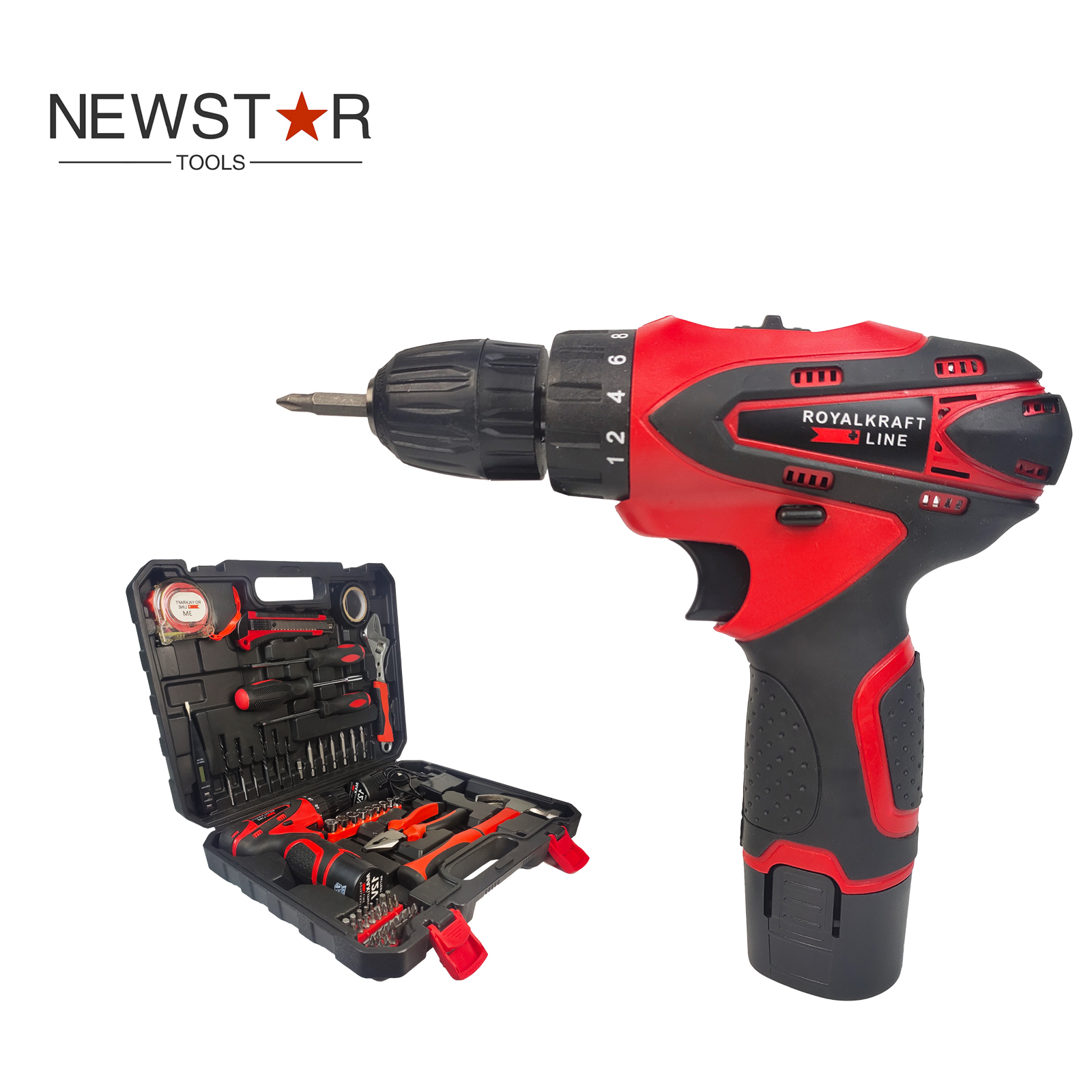
The defining factor between a drill that effortlessly drives lag bolts and one that stalls or burns out isn't just battery voltage—it is the internal gear reduction mechanism. Professionals and serious DIYers frequently misjudge tool capabilities, leading to stripped gears, ruined materials, and premature motor failure. Selecting an improperly geared drill limits the overall utility of any tool investment. Understanding the mechanical realities of a two-speed gearbox is the most critical evaluation metric when upgrading or purchasing a new Power Tool Set. This guide breaks down how gear ratios dictate performance, how to match gears to specific applications, and how to evaluate gearbox durability before purchasing.
- Torque vs. Speed Trade-off: Gear 1 provides torque multiplication (often 15:1 to 25:1 reduction) for heavy-duty driving, while Gear 2 prioritizes RPM for rapid, clean drilling.
- Application Specificity: Utilizing the incorrect gear for a task (e.g., using Gear 2 for a large hole saw) is the primary cause of thermal overload and motor failure in cordless drills.
- Energy Efficiency & Run-Time: Proper gear matching directly improves energy efficiency, reducing battery draw and extending the work cycle of your cordless drill tool kit.
- Kit Evaluation: The material construction (all-metal vs. composite) and shifting mechanism of the gearbox should dictate which power tool combo kit you shortlist for professional or heavy-duty use.
- Complementary Tools: For precision, low-torque tasks, a dedicated cordless electric screwdriver kit often outperforms a heavy two-speed drill, highlighting the need for a balanced tool arsenal.
The Mechanics of a Two-Speed Gearbox in Modern Drills
Modern drills rely on a two-stage reduction gearbox using planetary gears. Moving the gear selector engages different sets of planetary gears to alter the ratio between motor RPM and chuck RPM. This mechanical adjustment allows the drill to adapt to varying load requirements efficiently. You are essentially changing the physical relationship between the spinning armature of the motor and the chuck holding your bit.
Different gear sizes and arrangements alter rotational speed to multiply force. Speed reducers are generally more efficient in power transmission for high-resistance tasks compared to speed multipliers. This principle is fundamental to how drills deliver usable power on the job site. When you drop a drill into low gear, the internal ring gear locks, forcing the planetary gears to walk around the sun gear, drastically reducing output speed while multiplying torque.
Gear 1: Low Speed, High Torque (The Power Gear)
Gear 1 reduces motor speed to roughly 300-500 RPM while multiplying rotational force with a 15:1 to 25:1 reduction ratio. High resistance requires mechanical leverage rather than just electrical power. This gear provides the necessary torque to drive large fasteners through dense materials without stalling. If you are sinking half-inch lag bolts into pressure-treated lumber, Gear 1 is the only option that will not fry your stator.
The physics of torque delivery dictate that as speed decreases through gear reduction, twisting force increases proportionally. This mechanical advantage means the motor draws less amperage to perform heavy work, keeping internal temperatures down. Relying on electrical power alone to force a bit through tough material in high gear will quickly trigger the battery's thermal protection circuit.
Gear 2: High Speed, Low Torque (The Speed Gear)
Gear 2 utilizes a bypass or secondary engagement that allows higher RPMs, typically 1,500-2,000+ RPM. High speed is necessary for material removal and chip clearing in softer materials without bogging down. It ensures clean holes and rapid progress on lighter tasks. When drilling pilot holes or using small twist bits in pine, Gear 2 clears the wood chips fast enough to prevent the bit from binding.
In this setting, the planetary gear carrier locks directly to the output shaft, providing a direct 1:1 drive ratio from the first reduction stage. The motor spins fast, and the chuck spins fast. However, because there is minimal secondary gear reduction, the twisting force is significantly lower. Pushing too hard in Gear 2 will stall the motor instantly.
The Synchronizer Contrast (Why Drills Can't Shift on the Fly)
Unlike automotive direct-shift gearboxes equipped with synchronizers, a drill uses a manual sliding gear selector. The lack of synchronizers means gears must be fully stationary before shifting. Attempting to shift while running can cause tooth shear and "neutral" gear slips. You will hear a loud grinding noise, which is the sound of the metal dog teeth rounding off.
Internal components vary significantly across models. Professional tools feature machined steel gears, while mid-range options might use powdered metal. Budget models often rely on nylon or plastic gears, which lack the durability for sustained heavy-duty applications. Knowing what is inside the casing helps you understand the tool's limits.
| Gear Setting | Typical RPM Range | Torque Output | Primary Application | Risk of Misuse |
| Gear 1 (Low) | 300 - 500 RPM | Maximum (High) | Large hole saws, auger bits, lag bolts | Over-torquing small screws, snapping bits |
| Gear 2 (High) | 1,500 - 2,000+ RPM | Minimum (Low) | Small twist bits, pilot holes, soft wood | Motor burnout, thermal overload, stalling |
![Power Tool Gearbox Mechanics]()
Application Matrix: Matching Gear Ratios to Drilling Tasks
Matching the correct gear to the task is essential for tool longevity and performance. Operating a drill outside its optimal gear range places unnecessary stress on the motor and battery. You need to read the material and the fastener to make the right call.
Heavy-Duty Fastening and Large-Diameter Drilling (Gear 1)
Gear 1 is designed for driving lag screws, using auger bits, operating large hole saws, and mixing joint compound. The drill must maintain consistent RPM under heavy load without the battery protection circuit tripping. Operating in Gear 1 for high-torque demands maximizes energy efficiency by keeping motor current draw within safe limits.
When using a 2-inch hole saw through a solid core door, the surface area of the cutting teeth creates massive friction. Gear 1 provides the mechanical muscle to keep the teeth biting and turning. If you try this in Gear 2, the drill will either violently twist out of your hands when it catches, or the motor will simply stop dead.
Rapid Drilling and Pilot Holes (Gear 2)
Gear 2 excels at drilling into wood with twist bits, drilling through thin sheet metal, and driving small fasteners. The goal is clean entry and exit holes without material tear-out, achieved through high RPM chip ejection. This gear provides the speed needed for efficient progress on lighter tasks.
Speed is your friend when drilling metal with a step bit or a titanium twist bit. You need the RPMs to let the cutting edge do the work rather than relying on brute downward force. Gear 2 keeps the bit moving fast enough to slice through the material cleanly.
Task-Specific Limitations
There is a threshold where a standard two-speed drill becomes inefficient. For delicate, repetitive fastening, transitioning to an impact driver or a specialized cordless electric screwdriver kit is often necessary to prevent material damage and improve workflow. A heavy drill is fatiguing when installing cabinet hinges all day.
Here are the steps to determine if you need to switch tools entirely:
- Assess the fastener size. If it is smaller than a #6 screw, a heavy drill is overkill.
- Evaluate the material. Softwoods and MDF require precision to avoid stripping.
- Consider the volume. Driving 500 screws is better suited for a lighter, dedicated driver.
- Check clearance. Tight spaces often prohibit the use of a full-sized two-speed drill.
Evaluating Drill Performance Within a Power Tool Set
When assessing a drill, consider how its features interact to produce the desired outcome. The synergy between components dictates the tool's overall capability. You cannot look at the gearbox in isolation; it works as part of a complete system.
Feature-to-Outcome Mapping
Brushless motors interact with two-speed gearboxes to provide better battery efficiency and sustained torque compared to brushed motors. The adjustable clutch works in tandem with Gear 1 to prevent over-driving fasteners, offering precise control during heavy applications. The clutch disengages the transmission from the chuck when a specific torque limit is reached.
This mechanical disconnect saves your wrist and prevents the screw head from burying itself an inch deep into your workpiece. When evaluating a drill, test the clutch collar. It should click positively into each setting and hold firm under load.
Standalone Units vs. Comprehensive Kits
Evaluate the cost-to-capability ratio of buying a bare tool versus investing in a complete cordless drill tool kit. Battery amp-hour (Ah) ratings included in kits impact gearbox performance; high-draw applications in Gear 1 require high-output batteries to maintain torque. A 1.5Ah battery will struggle to deliver the sustained amperage needed for heavy auger drilling, even in low gear.
Kits often bundle higher capacity batteries (4.0Ah or 5.0Ah) that utilize double rows of lithium-ion cells. These packs can discharge current faster, feeding the motor exactly what it needs when the gearbox is under maximum strain.
Gearbox Reliability & Switch Tolerance
Test the tactile feedback of a gear selector to ensure positive lock engagement. A firm lock prevents slips into a mechanical "neutral" under load, which can damage the internal components. Scalability for future projects should also be assessed. Determine if a standard compact two-speed drill is sufficient, or if a heavy-duty hammer drill is required for masonry and concrete scalability within a power tool combo kit.
If the gear switch feels mushy or requires you to wiggle the chuck to get it to seat properly, that is a red flag. The internal shift fork might be weak, or the dog teeth might be poorly machined. A quality tool snaps into gear with authority.
Implementation Risks and Mitigation Strategies
Improper use of a two-speed gearbox can lead to severe tool damage. Understanding these risks allows operators to implement effective mitigation strategies on the job site.
Risk 1: Shifting Under Load (Gear Grinding)
Forcing the gear selector switch while the chuck is spinning grinds the planetary gear teeth and dogs because the drill lacks synchronizers to speed-match the gear sets. Standard operating procedure requires coming to a complete stop before toggling between high and low gears. Treat the gear switch like a mechanical lockout, not a gas pedal.
Risk 2: Thermal Overload (The "Wrong Gear" Problem)
Running a large spade bit in Gear 2 forces the motor to draw excessive current to maintain RPM, leading to rapid heat buildup and potential stator burnout. Strict adherence to application matrices is necessary—always default to Gear 1 for bits larger than 1 inch or when resistance spikes. If the tool is too hot to hold comfortably, you are likely in the wrong gear.
Risk 3: Over-Torquing Small Fasteners
Using Gear 1 on delicate materials can easily strip screw heads, snap shafts, or damage the workpiece. Proper clutch setting utilization or switching to a lower-voltage, precision-focused tool within your power tool combo kit mitigates this risk. Do not rely solely on trigger control when driving small brass screws; the mechanical advantage of Gear 1 will snap them instantly.
Conclusion
A two-speed gearbox is a mechanical necessity that dictates the functional range of a drill. The ability to toggle between torque multiplication and rapid material removal is what makes the drill the most versatile tool in your arsenal. When evaluating a power tool set, prioritize kits that feature all-metal planetary gearboxes, distinct RPM ranges for Gear 1 and Gear 2, and seamless, non-sticking gear selectors.
- Audit your current and projected project requirements to determine necessary torque levels.
- Prioritize high-torque, heavy-duty kits if your work heavily skews toward large fasteners and masonry.
- Evaluate kits that include supplementary low-torque drivers if your work is precision-based.
- Inspect the gear selector mechanism for positive engagement before purchasing.
FAQ
Q: What is the difference between Gear 1 and Gear 2 on a drill?
A: Gear 1 provides low RPM and high torque through mechanical reduction ratios, ideal for heavy driving. Gear 2 offers high RPM and lower torque, suited for rapid drilling in softer materials.
Q: Can I shift gears on my drill while it is running?
A: No. Drills lack synchronizers. Shifting while running grinds the gears and can cause severe mechanical damage. Always stop the motor completely before shifting.
Q: Why does my drill stall when using a hole saw in Gear 2?
A: Gear 2 lacks the necessary torque for large diameter bits, causing the motor to draw excessive current and stall or overheat. Transitioning to Gear 1 provides the required mechanical leverage.
Q: Do all cordless drill tool kits come with two-speed gearboxes?
A: While standard on most 12V and 18V/20V models, some entry-level or ultra-compact drills may only feature a single speed. Always verify the specifications.
Q: Is a two-speed drill better than an impact driver?
A: They serve different purposes. A drill provides continuous rotational torque via its gearbox, ideal for drilling holes. An impact driver uses concussive rotational force, better suited for driving large fasteners without cam-out.
Q: What does it mean when a drill gear selector gets stuck in between gears?
A: It means the internal dog teeth are not aligned. To fix this safely, slightly rotate the chuck by hand while applying gentle pressure to the selector switch until it clicks into place.
Q: How do I know if the gearbox in a power tool combo kit is durable?
A: Look for all-metal gear construction, check the manufacturer's reputation for heavy-duty tools, and review the warranty terms provided with the kit.